
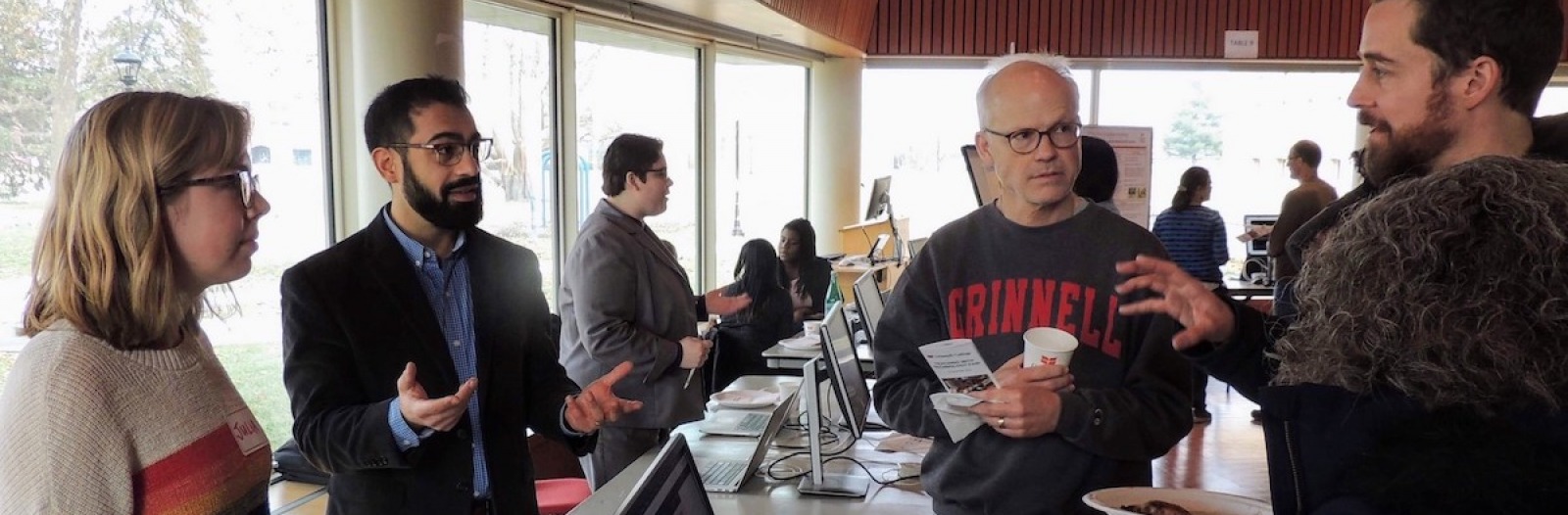
The Digital Liberal Arts Collaborative (DLAC) is a team of academic technologists and digital liberal arts specialists who support the incorporation of digital methods, applications, and practices into the teaching, learning, research, and scholarly life of the Grinnell College community. Positioned at the intersection of academic technology, the learning sciences, and the scholarship of teaching and learning, DLAC helps faculty, staff, and students think about the digital information ecosystem and design and implement effective practices for our learning and work. DLAC partners with other colleagues at the College who are engaged in supporting the digital liberal arts, such as the Libraries, Information Technology Services, and the Data and Social Inquiry Lab (DASIL).
Our projects span a broad range of academic and professional domains, both across the formal curriculum as well as the work of various offices, departments, and units of the College. We consult with faculty and help them design digital assignments, giving their students the opportunity to construct and present their knowledge in diverse modalities of form and media. We work with students to build their digital competencies and literacies and to prepare them to navigate the complex information landscape of our world. We help college programs and offices to improve the effectiveness of their workflows and to showcase the resources and services they offer to the college community.
DLAC Teaching with Technology Fair
Friday, May 8, 2026, Noon–1 p.m., Rosenfield Center, Room 101
The Digital Liberal Arts Collaborative sponsors the annual Teaching with Technology Fair to showcase innovative uses of digital methods, applications, and practices among Grinnell College faculty, students, and staff. The fair is an opportunity to share and discuss ideas for effective uses of technology in teaching and learning and to recognize faculty, students, and staff for their work in creatively integrating technology and pedagogy.
Our 2026 projects and presenters are:
- “Buried Chinatowns: The Wyoming Chinatowns Archeology Project,” with Laura Ng (Anthropology), Julia Ghorai ’27, Avajane Lei ’28, Luis Lopez ’27, & Jorge Salinas ’26
- “Campus Tree Map,” with Liz Queathem (Environmental Studies) and Gabriela Roznawska ’26
- “Collaborative Annotation for Classroom Discussion,” with Mariko Schimmel (Japanese) and JPN 241 students
- “Globalizing Danmei,” with shabab kabir ’26, Zoe Kirn ’26, and Amy Xinmeng Mi ’28
- “Grinnell College's Early Chinese Alumni,” with Jin Feng (Chinese) and Chikako Inoue ’26
- “Integrating Static Computing into Digital Projects and Pedagogy,” with Morgan Smith ’26, Sarah Purcell (History), and Mark McFate (Libraries)
- “Macroeconomies of the World,” with Ha Bui (Economics) and ECN 282 students
- “Prototyping, Customization, Accessibility, and Design: Thinking and Printing in 3 Dimensions,” with Max Schafer (Libraries)
- “Religious Healing Video Essays: Ayurvedic Medicine and Chiropractic Care in the United States,” with Dixuan Chen (Religious Studies), Cole Delaney ’27, Kevin Tang ’27, Benke Grobler ’27, Keisya Park ’26, Vidushi Keni ’26, and Filza Anis ’26
- "TDPS Media Archive,” with Kate Baumgartner (TDPS) and Chloe Kelly ’26
- "Totally Bananas! The Podcast,” with Paul Hutchinson (Education) and Nino Kirtava ’28
- “Video Essays for Literary Analysis,” with Erik Simpson (English), Sofia Bedoya-Correa ’29, Nicholas Rasmussen ’29, and Nicholas Toc ’28
- “Virtual Tithead Project,” with Adam Kelley-Chown (DAR) and Kiera Rennick ’26
- “Vivero Digital Fellows Program,” with Amy Kan ’27, Bruno Sica ’27, Cadence Chen ’26, Karolina Calleros ’26, Olyvia Liu-Cai ’28, Steph Kama-Kama ’28, Valery Mayorga ’26, Zachary Bressler ’26, Tierney Steelberg (DLAC) and Liz Rodrigues (Libraries)
See the Tech Fair website for further project descriptions.


