
5 Questions with Craig Quintero
Craig Quintero, professor and chair of Theatre, Dance, and Performance Studies at Grinnell College, is an internationally recognized theatre artist, director, and educator whose work bridges disciplines and cultures. In addition to his teaching, Quintero is the founding artistic director of Riverbed Theatre in Taiwan, where he has developed innovative, multimedia performances for nearly three decades. His global experiences — from studying abroad in China to building a long-standing creative practice in Taipei — inform both his artistic philosophy and his teaching at Grinnell, where he encourages students to “embrace the unknown.” Craig took a few minutes to reflect on the experiences, inspirations, and collaborations that shape his work on campus and beyond.
Q: What can you tell us about your family and your earlier years?
A: We moved several times during my childhood for my father’s work, so I have random memories of drinking roadside cepillados (shaved ice drinks) in Venezuela, eating boiled peanuts at Stone Mountain in Georgia, and hiking in the mountains of Montana. Although it was sometimes difficult to pull up our roots and relocate, I also feel very fortunate to have been exposed to diverse people and cultures from a young age. These travels helped instill in me a desire to travel and step outside of the familiarity of everyday life.
My childhood adventures led me to study abroad in China during my junior year at Tufts University and travel to Taiwan after graduation as a Rotary International Ambassadorial Scholar. When I first arrived in Taipei in 1992, I had no idea that Taiwan would become my second “home” and the site where I would form and run my theatre company, Riverbed Theatre, for the past 28 years! One of the main mantras in my classes is “embrace the unknown,” and I try to embody this ethos in both my art and life.
I am very fortunate to have a very close, tightly knit family. Despite their diverse professional careers (my dad was an engineer, my mother was a counselor, and my brother is a lawyer), they all have participated in my theatre productions in one capacity or another. My brother wrote the text for some of my early shows, my mom performed in seven of my productions and composed music for many others, and my dad was the sound board operator for four performances I directed at the Avignon-Off Theatre Festival in France.
The phrase “yes and” is central to improv theatre, an expression of the ensemble’s willingness to support a proposition from a team member and build from it. I have been blessed by my family’s “yes and” approach to my creative work. Their enthusiastic support enabled me to be bold in my decisions and step confidently into the unknown.
Q: What hobbies or activities keep you busy?
A: There is almost a seamless overlap between my professional interests (teaching, theatre) and my personal ones (painting, sculpture, film, music), so even when I am not “working,” I find myself daydreaming about new projects. I still sometimes almost have to pinch myself to be sure I’m not dreaming that people are paying me to do the work I love.
In my free time, I enjoy watching movies and going to the theatre and museums . We spend a lot of time focusing on “feeding our bodies” but often don’t leave enough time to “feed our heads.”
Q: What do you do for fun in your spare time?
A: I don’t cook very often, but when I do, I take a lot of pleasure in preparing a meal to share with friends and family. I probably have only made 20 of the 500 recipes in my NY Times Cooking “favorite” folder, but I am slowly chipping away at the list.
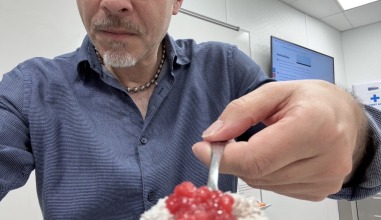
I included an assignment on molecular gastronomy in my Art of Transformation class this semester, and it was amazing to work with Daivd Stanley and the Global Kitchen team to develop an assignment in which students made “fruit pearls” and powdered Nutella. It’s always fun to make a project that you can eat!
Q: What is your favorite Grinnell moment to date?
A: I have a “favorite moment” on almost a daily basis. Highlights from this semester include working with four amazing student playwrights who each wrote their own original one act scripts that were performed as part of the Department of Theatre, Dance, and Performance Studies mainstage season in March. This was the first time students have written the plays for our mainstage production, and it was remarkable to see their ideas develop and flourish.
On a smaller but equally important level, I felt like I was floating after watching the last round of performances in my Art of Transformation and Introduction to Acting classes. In my Transformation class, students keep raising their own personal bar as they write, design, and perform their own original works. The last round of performances about “nature” included immersive installations, tightly choreographed dances, original films, and hand-made puppets. Although they might not be fully aware of it, they are creating powerfully poetic and deeply personal works of art. In my Acting class, it is a pleasure to see students with limited to no acting experience gain confidence in themselves. Although maybe only a few will continue acting, they have all made great strides in physically and emotionally grounding themselves as artists and people.
Q: Outside of classes, what are the other joys of working at Grinnell?
A: Beyond our amazing students, one of the greatest joys of teaching at Grinnell is the opportunity to collaborate with my colleagues. Whether it was working with John Rommereim and eight students on an original adaption of Wagner’s Das Rheingold as part of a Summer MAP, co-directing a performance for an audience of one with Andrew Kaufman at Taipei MOCA, or curating an exhibition about cloning/genetic engineering at that featured artworks by Jeremy Chen, Mirzam Perez, Andrew Kaufman, and Emily Yurkevicz at the Tainan Art Museum, these projects have embodied the collaborative ethos at the heart of the Grinnell experience, that by working together we can exceed the limits of our own imagination.