
Believing in Grinnell
Loyal annual donors since graduation, Janet Deyo Pugh and Tom Pugh support the College to spur on students with a variety of interests.
Jeremy Shapiro
With its individually advised curriculum and more than 500 dynamic course offerings, Grinnell College is ideal for students investigating a range of interests. That was part of the appeal for 1968 graduates Janet Deyo Pugh and Tom Pugh, who met on campus and credit Grinnell with changing their lives for the better.
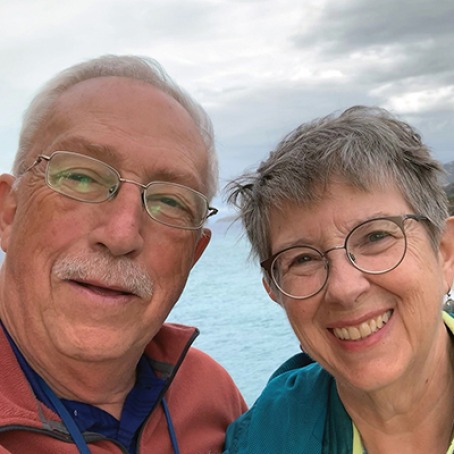
While Janet can’t tell you exactly what she learned in her Grinnell College classes during the 1960s, she knows that they are part of her.
“What I learned back then makes me who I am,” she says. “We give to Grinnell because a liberal arts education is something that I truly believe in, and even more as the years go by and I see the demands for career-oriented education.”
Janet and her husband, Tom, have made gifts to the College almost every year since they graduated. Most of the couple’s contributions have been to the Pioneer Fund and the Liberal Arts in Prison Program.
It’s important to the Pughs to make a gift to Grinnell every month that supports the Pioneer Fund, an unrestricted fund that addresses the greatest student needs and empowers the College to respond to issues and opportunities across campus.
“To me, giving to the Pioneer Fund means that I trust the College to do what it does well, which is educate students to be useful good people in the world today,” Janet says. “There are all kinds of places you could specify money, but I do believe in underwriting the day-to-day whatever needs to be done.”
The Liberal Arts in Prison Program is near and dear to Janet as she volunteers with a restorative justice program in prisons near where the Pughs live in Madison, Wisconsin. Grinnell’s Liberal Arts in Prison Program enrolls incarcerated students at the Newton Correctional Facility and the Iowa Correctional Institution for Women in a demanding college program that offers up to 60 credits from Grinnell College.
“What the College is doing is absolutely wonderful; it’s one of the best things that could happen in a prison,” she says. “And I’m really proud of the College for doing that. I’ve been over to the facility and talked with the students over there. I’m just thrilled that Grinnell can be counted among the colleges and universities in the country that have that kind of program.”
A self-described “townie,” Tom grew up in Grinnell and lived off campus as a student.
“For social purposes, all the townies were attached to Rawson Hall, and I remember we held our hall meetings during the commercial breaks of the TV show The Man from U.N.C.L.E,” he said. “It’s strange images like that that are in my memories about Grinnell until Janet and I met our senior year, whereas then my memories are much more the places we went and things we did together.”
Janet went to high school in Dallas. Their family’s introduction to Grinnell came when her mom found a magazine article about liberal arts colleges that were relatively affordable.
“One of the reasons I was interested in Grinnell was that they had, at the time, an area studies program,” she says. “What it meant was that I chose a major, which was history, but then I was able to take classes in anthropology, political science, and economics, and I really liked having that variety of classes.”
That variety still is one of the most appealing things about Grinnell to the Pughs, more than a half century later, especially compared to schools like the University of Wisconsin, where Tom conducted liver cancer research in the Pathology Department and then aging research in the Department of Medicine until his retirement.
“At other schools, if you’re in biochemistry, you’re in biochemistry,” he says. “That’s who your faculty people are. At Grinnell, if you’re a biochemist and you go to a faculty meeting, you’re talking with the Spanish professor, you’re talking with the econ professor, you’re talking with a sociologist, and so you are crossing those boundaries. There’s this cross-fertilization of ideas where people ask, ‘What are you interested in?’ I’m interested in everything. I’m curious. I want to know things. And it doesn’t matter what discipline they come from.”
Tom has noticed a similar theme when talking with his classmates about their lives and careers.
“In our class, students were interested in so many different things, and they almost all begin their stories by saying, ‘Well, I started out as an A, and then after about four or five years, I became B. And then, much later after the kids left the house, I became C.’ Grinnell graduates are prepared to go different directions.”
Janet can attest to this. She started out teaching in Kenya before going to graduate school in library studies. She later worked for the Wisconsin State Bureau of Labor Statistics, creating a library and providing reference services. She has also done coordination volunteer work for the Wisconsin Conference of the United Church of Christ for the past 19 years.
With a relatively short drive from Madison, the Pughs have returned to Grinnell for events and have served on committees planning class reunions. The class of 1968 remains a tight-knit group, in part because of the fiery time they experienced together as students, with the Vietnam War raging and changes in society.
“That was an interesting time that we went through together,” Tom says.
The class of 1968 will join with the classes of 1969 through 1972 in a supercluster celebrating their 55th reunions during Reunion 2026 on May 28–31, 2026.
Making an annual gift to Grinnell fuels students’ curiosity, ambition, and innovation. Learn more about giving options.
Originally published in the Fall 2025 issue of The Grinnell Magazine.