
Building Networks for Systems Change
Grinnell hosts global educators to explore complexity, collaboration, and new approaches to systems change.
Emma Stefanacci
On November 13, educators from around the world gathered at Grinnell College to connect, learn, and gather tools to better support systems change and education. The gathering also served as a kickoff Systems. Change. Educators. Unite., a community designed to connect and support those who work on understanding, shifting, and teaching about complex systems.
Systems change practitioners and educators recognize the inherent complexity of social challenges and rely on nonlinear approaches to understand and address them. Instead of trying to “fix” surface-level symptoms through cause-and-effect logic, they work to identify and shift the interconnected root causes that shape a system’s behavior. By shifting the system itself, symptoms are addressed at a deeper level, leading to more sustainable and lasting change.
The conference was led by Daniela Papi-Thornton, an educator and coach focused on systems-led leadership, and hosted by the Center for Careers, Life, and Service’s civic education and innovation (CEI) team — a result of a 2010 student government initiative. CEI staff supports curricular and co-curricular experiential learning initiatives that invite students to think critically about how their experiences and education inform how systems work and how they might want to contribute to civic change.
Susan Sanning, associate dean and director of civic education and innovation, and Vicki Nolton, assistant director for social innovation partnerships and education, work with students who are interested in social innovation and shifting challenging systems. One of the programs they support is Map the System, a global competition that provides students and their community team members with systems thinking tools necessary for delving deep into a social or environmental issue that matters to them and to explain its complex connecting elements to others in a way that is understandable.
An Overview of Complexity
Prior to the professional gathering, Daniela Papi-Thornton facilitated a workshop in the Weingart ’61 Civic Innovation Pavillion (designed for community engagement) and opened it to the larger campus community, encouraging students to participate. The session helped participants distinguish between linear and systems thinking and introduced practical tools for understanding how systems shift and evolve.
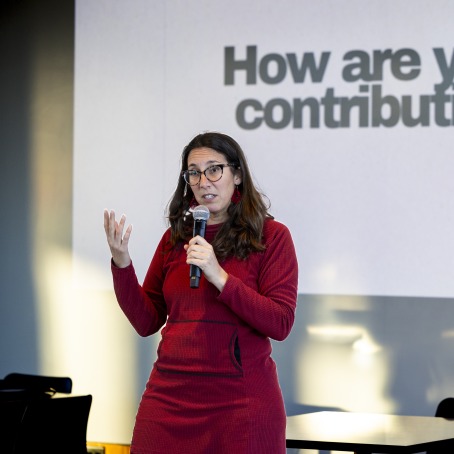
The workshop began by exploring what it means to think in terms of complexity when considering how to contribute to positive social change. Papi-Thornton opened with an exercise where pairs shared their answer to the question “What problem are you working to solve?” The participants named the social issues that matter to them, while acknowledging how overwhelming and isolating it can feel to imagine solving such large challenges alone. They then answered a second question: “How are you a contribution?” This reframing helped participants recognize that their experience, strengths, and skills position them to contribute meaningfully to broader efforts for change rather than carrying the full responsibility themselves.
This discussion moved into analogies about problems that can be solved with linear solutions (even if they are complicated), like fixing a smartphone that is broken vs. complex systems that can’t be solved but can be changed. Many of the “problems” the attendees hoped to solve are actually the results of larger systems dynamics, therefore trying to “fix” those problems will not work without shifting the systems that are creating them. Papi-Thornton stressed that contributing to shifting the systems may be a more optimistic, practical, and ultimately effective approach to create meaningful change.
She also emphasized that “the only guarantee in complexity is that there will be unintended consequences.” This also means that, to be effective, actors must follow up on the impacts of their action and adjust as they go or else risk simply impacting surface-level symptoms or causing more harm then good.
Learning to See the System
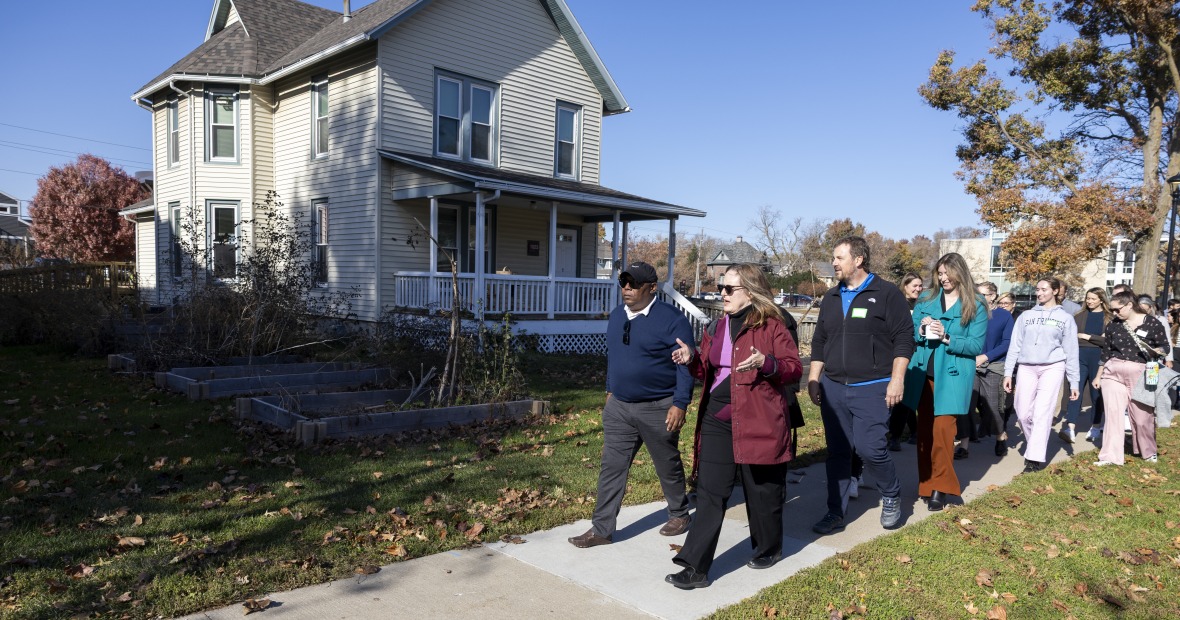
The next day, Sanning and Stephanie Badsoldier Snow ’03, an Indigenous anthropologist and education coordinator for the Meskwaki Nation, led a social justice tour for the attendees where they put learning into practice and explained some of the complexities in the systems that affect Grinnell. They talked about how the history of Iowa contributes to challenges like childcare and internet access in a rural area and the role that different community organizations play in running the town.
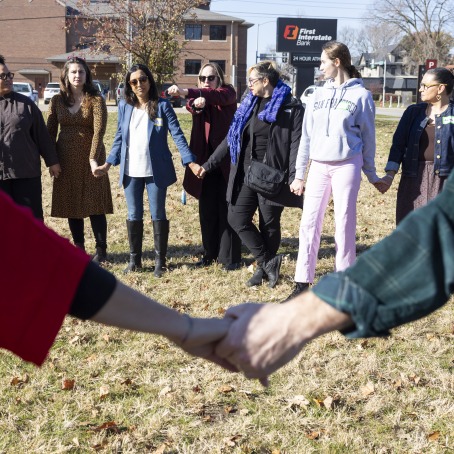
One of the interesting activities offered a physical illustration of how people contribute to change within complex systems. Sanning asked participants to line up along a continuum representing their approach, from “meet immediate needs” to “blow up the whole system.” Several participants shared their perspectives, highlighting the diversity of approaches. Sanning then transformed the line into a circle and finally an interwoven cluster, demonstrating that meaningful change requires multiple, interconnected actions. When efforts are coordinated and happen simultaneously, participants can stay connected to the larger system and contribute in ways that actually shift it, rather than merely addressing isolated symptoms. In the “interruption-encouraged space” of the tour, attendees asked thoughtful questions and offered insightful critiques, engaging critically with the systems framework. The exercise allowed participants to ground their discussions in the real-world context of Grinnell, IA, and brainstorm ways to apply their insights to their own work and interests.
Reflecting on the weekend, Sanning said, “The gathering was truly inspiring, and I’m excited that we now have a foundation to continue learning, collaborating, and deepening our work together in the future.” Both Sanning and Papi-Thornton regard the event as a success — weaving relationships across global educators and effectively launching this emerging community of social innovators.