
Finding the Story Behind the Cards
English major Isaiah Schlimm '27 explores how Magic: The Gathering reflects storytelling, history, and culture through a summer MAP

For most people, Magic: The Gathering is a collectible card game. For Isaiah Schlimm '27, it's also a text worth reading.
As part of his Mentored Advanced Project (MAP) in the Department of English, Schlimm is examining how one of the world's most popular trading card games tells stories—not just through its artwork and characters, but through the rules and mechanics that shape how the game is played. Working with Stephen Andrews, associate professor of English and director of the Center for the Humanities, Schlimm is examining what happens when a game known for its fantasy worlds ventures into new genres—and what those changes can reveal about culture and history.
Andrews says Schlimm's curiosity and preparation made the project stand out from the beginning.
"Isaiah combines intellectual curiosity with the ability to focus on a core idea that drives a project," Andrews says. "Isaiah had been reading ahead since last fall in preparation for this MAP. I was only too happy to help him follow it through."
Looking at Games Through a Literary Lens
First released in 1993, Magic: The Gathering has become one of the world's most popular trading card games. New expansion sets are released every year, giving players new cards to collect and new strategies to build into their decks.
Schlimm has been playing the game for most of his life.
"I've known how to play Magic for about as long as I can remember, thanks to my stepdad, who was patient enough to teach me the game after I got my first booster pack at a Dollar General in the second grade," he says. "I didn't really think about Magic as something that could be studied until I started reading up on game design and aesthetics in college."
That realization inspired his Summer MAP.
For decades, Magic was rooted in traditional fantasy, drawing inspiration from worlds filled with dragons, knights, and wizards. More recently, however, the game's creators have begun experimenting with entirely different genres, including science fiction, horror, and the American West.
"The visual and narrative design of Magic has changed, much to the mixed reactions of Magic fans," Schlimm says. "I think what's underlying this confusion and controversy is the fact that there's not really any good theoretical frameworks out there for how to talk about genre in games. Genre is such an important topic in literary studies that I thought analyzing Magic through my background in literary criticism might be helpful."
A New Frontier
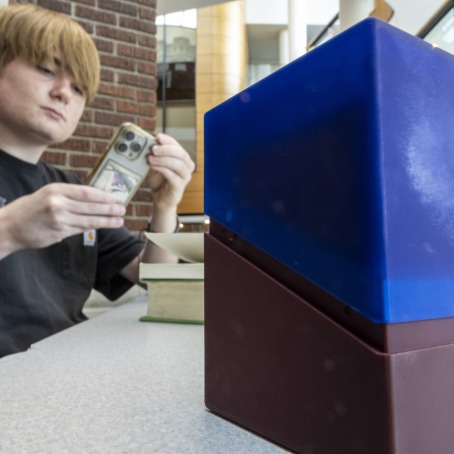
Schlimm's research focuses on the 2024 expansion Outlaws of Thunder Junction, which trades castles and kingdoms for outlaws, frontier towns, and the imagery of the American West.
His research asks a simple question with complex implications: What happens when a game changes its setting but keeps the same rules?
By closely reading the game's mechanics alongside its themes, Schlimm argues that the underlying gameplay still carries ideas from Magic's fantasy roots, even as the setting shifts to the frontier. His work also explores how those mechanics intersect with long-standing narratives surrounding westward expansion and colonization.
Rather than looking only at the artwork or written story, Schlimm is interested in how gameplay itself communicates meaning.
"I think an important move I'm making in my argument is that the design of a game's rules and mechanics can tell a story, just like the scenes of a movie or sentences of a paragraph do," he says. "In working on this MAP, I want to illustrate, through the example of Magic, that play is a form of narrative that involves rhetoric as well."
Andrews says that's where the humanities become essential. "In Magic, land and mana are intricately connected, and one is powerless to start without them," Andrews says. "Likewise, an analysis of Magic would be woefully incomplete without the analytical tools borrowed from the humanities."
Beyond Playing the Game
Schlimm's project also explores another side of Magic: collecting.
While many people build decks and compete, others rarely play at all, choosing instead to collect cards because of their artwork, rarity, or long-term value. Schlimm believes those different audiences may influence how new expansion sets are designed.
"I've been careful to use the term 'Magic fan' rather than 'Magic player,'" he says. "It is certainly possible for one to collect cards without ever having played a game of Magic in one's life. I think both practices come with different outlooks about the cards themselves."
During his research, Schlimm also uncovered unexpected connections between the game and broader cultural history, including learning that the game's resource system, known as "mana," traces its origins through decades of scholarship and popular culture before becoming a familiar game mechanic.
The Value of a Summer MAP
For Schlimm, one of the most rewarding parts of the experience has been the opportunity to devote an entire summer to a single research question.
"I really appreciate that my MAP has given me the opportunity to sit down and work with one specific project and really refine it," he says. "It was awesome to get to propose and direct a research project on my own initiative, and to pursue a project centered around a topic I might not really get to explore inside the classroom, like Magic."
He's also enjoyed working alongside Andrews and two fellow English MAP students, meeting twice each week to share drafts, exchange feedback, and strengthen one another's work.
Looking ahead, Schlimm hopes to continue refining his paper with the goal of presenting it at a conference or publishing it in a game studies journal. More importantly, he hopes readers leave with a new appreciation for the stories games can tell.
"I believe that this is important for game designers to know, so that they are conscious of the narratives they are designing in their games," Schlimm says. "It's also important for players to know, so they can be conscious enough of the narratives they consume through gameplay to decide whether to internalize them or reject them."
This story is part of Grinnell College's summer experiential learning series. This year, the College is investing more than $1.2 million to support Mentored Advanced Projects (MAPs) and student internships, creating opportunities for students to pursue original research, creative scholarship, and hands-on learning on campus and around the world. Read more about Grinnell's investment in experiential learning.