
Grinnell College to Celebrate the Installation of Four Endowed Professors
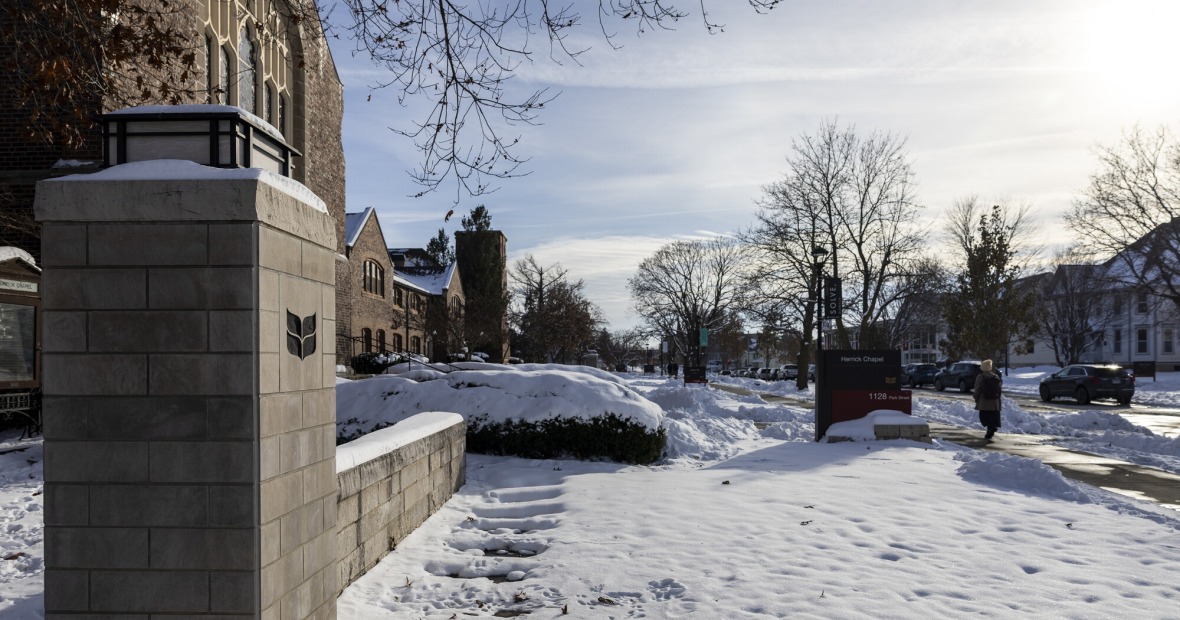
This formal celebration of faculty distinction on Thursday, February 5 in Herrick Chapel
Dear faculty, staff, and students,
I am delighted to announce the appointment of four distinguished faculty to endowed positions—one of the highest honors the College can award to members of its faculty. Endowed chairs and professorships recognize exceptional teaching, scholarship, and service, while simultaneously reflecting the enduring generosity and values of alumni and friends whose gifts strengthen Grinnell’s academic mission for generations to come.
I invite you to join us in celebrating these appointments at an endowed faculty installation ceremony on Thursday, February 5, 2026, at 4:15 p.m. in Herrick Chapel, with a reception to follow in the HSSC Atrium.
Please join me in congratulating the following faculty colleagues:
Karla Erickson, Professor of Sociology, will be installed as the Rosenfield Professor of Social Studies, a chair created in 1984 by Joe Rosenfield 1925, one of Grinnell College’s most influential alumni. Rosenfield’s lifelong commitment to Grinnell intertwined his financial acumen, civic engagement, and deep affection for the College; over decades of service on the Board of Trustees, his stewardship helped grow the endowment from a precarious position to a strong foundation that supports academic excellence and opportunity across campus. Rosenfield’s gifts also underpin the Joe Rosenfield Center and the Rosenfield Program in Public Affairs, International Relations, and Human Rights, ensuring his legacy remains central to the intellectual and communal life of the College.
Professor Erickson is a feminist ethnographer of labor whose scholarship examines interaction, care, and community in market and institutional settings. She earned her B.A. in English and Women’s Studies from Illinois Wesleyan University, followed by an M.A. in Liberal Studies from Hamline University, and a Ph.D. in American Studies, with a minor in Feminist Studies, from the University of Minnesota. Her first book, The Hungry Cowboy, explores how recognition and belonging are produced through everyday labor and social exchange in a Tex-Mex restaurant, while her second book, How We Die Now, centers the expertise of elder care workers and the rituals of leave-taking that shape contemporary experiences of aging and death. Currently, she is working on two related projects. Messy Humans: A Sociology of Human/Machine Relations, examines the social implications of artificial intelligence and automation, asking what emerging technologies reveal about human value, connection, and inequality, while Tethers and Tight Spaces explores the social dynamics and lasting changes wrought by the Covid-19 pandemic. Professor Erickson is deeply engaged in interdisciplinary teaching and mentorship at Grinnell. In addition to her scholarly contributions, she has provided significant institutional leadership at Grinnell College, including service as Associate Dean; two terms on Executive Council as Social Studies Divisional Chair; Chairships of Sociology, American Studies, and Gender, Women’s and Sexuality Studies; and as the Faculty Coordinator of the Mellon Mays Undergraduate Fellowship Program.
David Harrison, Professor of French and Arabic, will be installed as one of Grinnell’s two Orville and Mary Patterson Routt Professors in Literature. This professorship was established in 1989 through an estate gift from Orville and Mary Patterson Routt, both members of the Class of 1908. Orville Routt later served as president of Scripps College, and Mary Patterson Routt was a nationally known journalist, columnist, and longtime trustee of Scripps. Their philanthropy reflects a deep commitment to liberal arts education and to Grinnell College in particular.
Professor Harrison received his B.A. in French from Swarthmore College and his M.A. and Ph.D. in French from the University of Wisconsin–Madison. His scholarship focuses on seventeenth- and eighteenth-century French literature and culture, and he has particular expertise in theatre, novels, and translation. He is the principal translator and co-editor of La Princesse de Clèves by Lafayette: A New Translation and Bilingual Pedagogical Edition for the Digital Age (Lever Press, 2022), and his scholarship has appeared in both U.S. and European journals. At Grinnell, Professor Harrison teaches across all levels of the curriculum and has served the College in numerous leadership roles, including as Director and Interim Director of the Center for International Studies, and Department Chair of French and Arabic. Harrison was recently elected Executive Director of the Society for Interdisciplinary French Seventeenth-Century Studies, an international organization dedicated to fostering interdisciplinary work on early modern France, demonstrating both his leadership in the field and also his commitment to advancing global scholarly exchange.
Vida Praitis, Professor of Biology, will be installed as the Rosenthal Professor of Natural Sciences and Mathematics. This professorship was created by Samuel Rosenthal, a former trustee of the College, and Marie-Louise Rosenthal, whose philanthropy includes multiple endowed professorships, a major scholarship, and significant support for the Grinnell College Museum of Art. The Rosenthal family’s generosity has had a lasting impact across the sciences and the arts at Grinnell.
Professor Praitis received her B.A. in Biology from Swarthmore College and her Ph.D. from MIT in Biology, followed by postdoctoral work at the University of Chicago in the Department of Molecular Genetics and Cell Biology. Her research in developmental genetics and cell biology focuses on mechanisms that regulate cell migration during embryogenesis, using the model organism C. elegans. In addition to developing a gene delivery technique that advanced research questions in C. elegans laboratories across the world, her work contributes to our understanding of fundamental processes underlying the development of organs and tissues in animals. At Grinnell, Professor Praitis is widely respected for her research mentorship, teaching excellence, and commitment to undergraduate scientific inquiry. She has also provided significant leadership at Grinnell, including service as Chair of the Faculty, Chair of the Science Division, Chair of the Biology Department, and Chair of the Biological Chemistry Program. Professor Praitis was recently selected to serve on the Genetic Society of America’s Education Committee.
John Thabiti Willis, Professor of African Diaspora Studies, will be installed as the inaugural Kesho Scott Endowed Chair in African Diaspora Studies. This endowed chair honors the legacy of Dr. Kesho Scott, DSS ’21 — a distinguished scholar, writer, and educator whose 38-year career at Grinnell College helped shape generations of students and played a pivotal role in the creation of the African Diaspora Studies department. Made possible through the generosity of alumni and friends, the Kesho Scott Endowed Chair affirms the College’s enduring commitment to interdisciplinary scholarship on Africa and its global diasporas.
Professor Willis is a scholar of African and African Diaspora history whose research explores performance, labor, heritage, and memory across the Atlantic and Indian Ocean worlds. He earned his B.A. in Accounting from Clark Atlanta University, followed by an M.P.S. in African and African American Studies from Cornell University, and an M.A. and a Ph.D. in African History from Emory University. His first book, Masquerading Politics: Kinship, Gender, and Ethnicity in a Yoruba Town, Otta, 1774–1928 (Indiana University Press, 2018), received multiple honors, including a 2019 Finalist for the Best Book Prize in African Studies and the 2020 Yoruba Studies Book Prize. His current Mellon-supported research uses GIS and critical heritage studies to recover the histories of Africans and their descendants in Gulf pearling communities. He is the inaugural chair of the African Diaspora Studies program at Grinnell, where his teaching, scholarship, and leadership are central to the growth and visibility of the program.
I invite you to join me in celebrating and congratulating Professors Erickson, Harrison, Praitis, and Willis on these well-deserved honors, and in thanking the donors whose generosity continues to shape the intellectual life of Grinnell College. I look forward to welcoming you to this formal celebration of faculty distinction on Thursday, February 5.
Thank you,
Ruth P. Feingold
Vice President for Academic Affairs and Dean
Grinnell College