
Grinnell Power Partnership Improves Sustainability
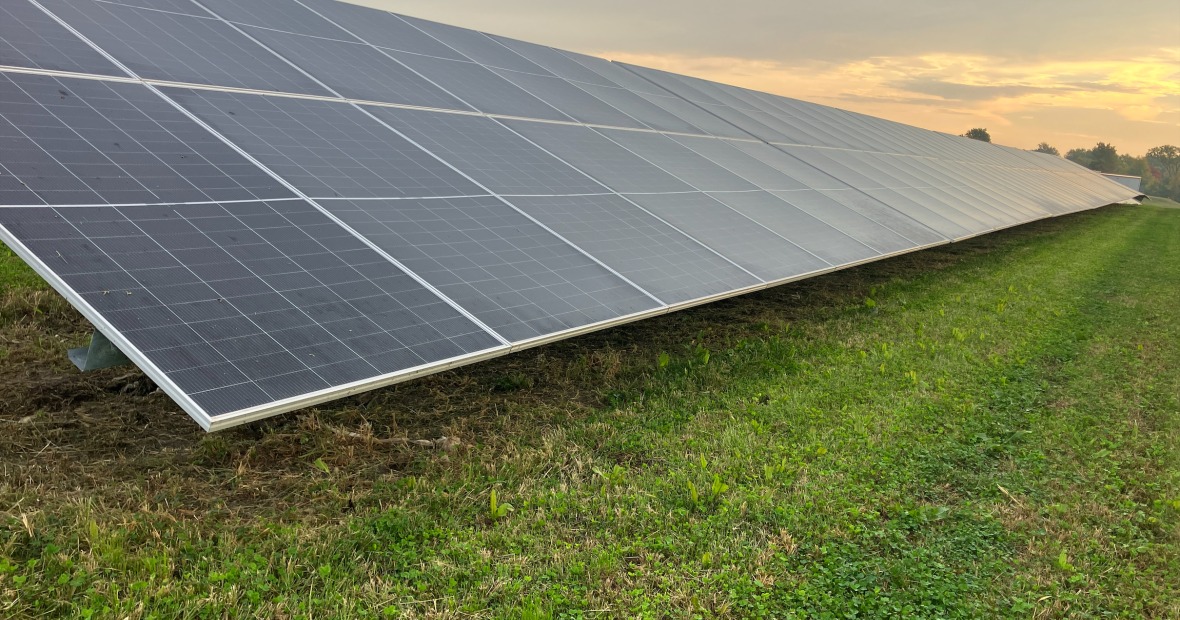
A new solar-power partnership between Grinnell College, local power company Alliant Energy, the Ahrens Family Foundation, the Mayflower Community, and the City of Grinnell became operational recently, generating 3.15 million kilowatt hours of electricity a year to the College and ensuring that 75% of its power will come from renewable sources.
Situated on 19.25 acres of land on the west side of the city, the Grinnell Solar Park is collectively owned by Grinnell College, the Ahrens Family Foundation, the Mayflower Community, and the City of Grinnell. Alliant Energy leases the land and operates the solar array.
The Solar Park is the second solar power partnership Grinnell has forged in the last two years. In 2024, Grinnell entered into a power-purchase agreement with Pioneer Solar, which operates a solar array in the northern part of the city, that provides 32% of the college’s electricity. At the time, the Pioneer Solar installation was the largest in the state.
Grinnell can now boast that 75% of its energy now comes from renewable sources. The two solar projects—the Solar Park and the Pioneer Solar partnership—now account for almost half of Grinnell College’s electricity needs, a significant commitment to renewable energy. The remaining electricity to power the campus comes directly from Alliant Energy, whose grid is 50% renewable.
The Pioneer Solar project offsets 18% of campus emissions, while the recently operational Solar Park offsets 9%.
In a few short years, Grinnell has made significant strides in powering its campus with renewable energy.
“We are light years better than we were,” says Chris Bair, environmental and safety manager for Grinnell College. “There aren’t many campuses that have used so many models and been so flexible in finding ways to use renewable energy and lower emissions.”
The commitment that Grinnell has made to using energy from renewable sources is the result of a focus on sustainability that began back in 2017 with the formation of a Fossil Fuels and Climate Impact Task Force by the Board of Trustees, the subsequent creation of a Sustainability Committee, and the institutional adoption of a formal Sustainability Plan in 2018. That plan provided a road map to increased sustainability and set a goal of net-zero greenhouse gas emissions by 2040.
Responsible environmental stewardship is also a component of the College’s strategic plan, Knowledge into Action, which sets as an objective to have “Grinnell’s campus planning, institutional policies, and external partnerships demonstrate a deepened stewardship of our environment.”
The solar-power partnerships are essential in reaching this strategic-plan objective, but other recent initiatives have helped to foster what the Strategic Plan calls a “land ethic that centers on biodiversity and sustainability.” In spring 2024, Grinnell partnered with Re:wild Your Campus and Beyond Pesticides to eliminate the use of pesticides on the College’s MacEachron Field through a pilot project of land management that used aeration, seeding, compost, and organic fertilizers.
The Center for Prairie Studies and Facilities Management, in a project driven by students, developed a tract of land near the Harris Center with plants indigenous to the prairie region; the College recently selected another plot of land on the South Campus for a similar seeding, which occurred on Earth Week. Grinnell is also developing a virtual arboretum that will allow people to find information online, direct from their phones, about all tree species on campus and their ecological benefits.