
A Life in Africa, a Legacy at Grinnell
After a career spent navigating some of Africa’s most consequential moments, Tony Dalsimer is helping Grinnell students discover the continent for themselves.
Tim Schmitt
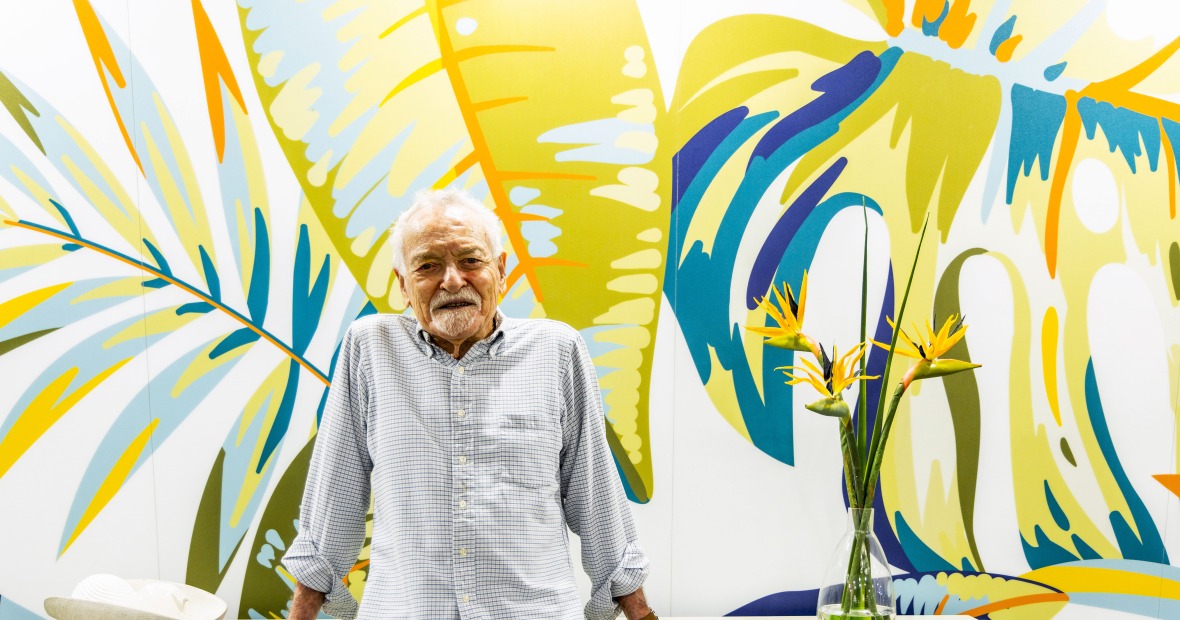
Tony Dalsimer ’57 likes to describe himself simply.
“I’m not much of an orator,” he says. “I’m more of an action person in my day-to-day life, and my assignments in Africa were certainly the same.”
It’s an honest assessment from someone whose career in the U.S. Foreign Service placed him at the center of some of the most turbulent moments in modern African history. Over four decades, Dalsimer served at American embassies across the continent, helping navigate political upheaval, humanitarian crises, and the uncertain early years of newly independent nations.
Today, his focus is no longer on diplomacy but on education. Through the Anthony S. Dalsimer Fund for the Study of Africa, he is ensuring that Grinnell students can engage directly with the people, cultures, and histories that shaped his own life.
What began years ago as a planned estate gift has now been transformed through a major lifetime contribution of more than $4 million, allowing Dalsimer to see the impact of his generosity while he is still able to follow the journeys of the students it supports.
For him, the goal is straightforward.
“I feel Africa is a part of the world that should be better known,” he says. “It has a lot of potential, and it has people who can develop it and improve their connections with the rest of the world. Whatever can be done to keep Africa in the consciousness of Americans is worth doing.”
Drawn to a Changing Continent
Dalsimer’s interest in Africa developed alongside that of the United States in the early 1960s. As former British and French colonies gained independence, President John F. Kennedy’s administration encouraged Americans to become involved in the development of these new nations.
“President Kennedy and the State Department were calling for volunteers, looking for people interested in going to Africa to work,” Dalsimer recalls. “And that captured my imagination.”
A second influence came through his wife, Scotty, whose work at the African American Institute introduced him to African diplomats and visitors in Washington, D.C. “Because of her job, I got to meet a fair number of African visitors and African diplomats who were assigned to Washington,” he says.
Those experiences launched a career that would take him to countries including Burkina Faso, Chad, Congo, Mali, Northern Somalia, and Zaire (now the Democratic Republic of the Congo). His service often unfolded against the backdrop of coups, civil unrest, and struggles for self-determination.
One assignment stands above the rest. While serving as deputy chief of mission in N’Djamena, Chad, in 1979, rival rebel armies entered the capital and plunged the city into chaos. With the U.S. embassy damaged by fighting and communications reduced to a single hour each day via shortwave radio, Dalsimer found himself responsible for getting roughly 80 to 90 Americans to safety.
Coordinating an emergency evacuation through a combat zone while navigating through endless bureaucratic red tape was no easy task. And when the U.S. Air Force declined to assist, Dalsimer convinced the French government to provide an airplane to get the Americans out of the country.
“The French did it,” he says, severely understating his role in the evacuation. “They were wonderful — incredibly helpful.”
The experience left a lasting impression, not because of the danger, but because of the resilience and generosity he witnessed throughout his years on the continent.
Seeing Africa Through New Eyes
For Dalsimer, one of the greatest lessons Africa offers is perspective.
“The most striking thing is how extremely different things are in Africa compared to the United States,” he says. “One thing that impressed me in most countries where I lived was that people were happy.”
Recalling his first assignment in what is now Burkina Faso, he adds, “The people there were wonderful. They really didn’t have much, but most were subsistence farmers, and they usually had some surplus grain crops like millet and sorghum to sell in the markets. The society was cohesive, and as far as I could tell, people were content.”
His personal experiences with the land and people of Africa led to his conviction that there is no substitute for experiencing another culture firsthand, which ultimately inspired his philanthropic efforts.
When Dalsimer retired from the Foreign Service in 1997, an unexpected lump-sum pension payment gave him the opportunity to do something meaningful.
“There really wasn’t anything I wanted to do with it here in the States,” he says. “So, I decided I would set up a fund for the study of Africa with Grinnell.”
Opening Doors for the Next Generation
Today, the Anthony S. Dalsimer Fund for the Study of Africa helps Grinnell students pursue study abroad and other immersive learning experiences connected to the African continent.
“Tony Dalsimer’s distinguished career in foreign service — and his post-retirement engagement working at the National Archives; teaching courses in African history, government and politics, and international relations; and volunteering in his community — are a testament to his commitment to serving the common good,” President Anne F. Harris says. “The remarkable generosity he has shown by creating the Anthony S. Dalsimer Fund for the Study of Africa ensures that future students can have extraordinary opportunities to experience Africa for themselves in ways that will indelibly shape their lives and how they live Grinnellian. We are grateful both for Tony’s example of a life well lived and for his philanthropic support of future Grinnellians.”
The impact of that support can be seen in the experience of Liv Larsen ’26, a recent English and film and media studies graduate who spent a semester studying at the University of Cape Town through IES Abroad.
Larsen considered several destinations before deciding on South Africa. “I was attracted to Cape Town because of the climate and beach, the mountains, but also the music and the arts and the people there,” she says.
The financial support she received was essential in making the experience possible.
“Studying abroad in general can be difficult because there are so many costs added on,” she says. “A flight just to get there can be very expensive, plus I was living in an apartment and the cost of rent, food, and all the little things add up.”
But the Dalsimer Fund coupled with institutional support made the dream achievable for Larsen, she says. “Living in Cape Town for five months is something I doubt I’ll ever be able to do again, and to have had that opportunity was incredible.”
Larsen deliberately chose a direct enrollment program so she could learn alongside South African students rather than remain in a cohort of visiting Americans. In classes on literature, history, and photography, she encountered new perspectives that reshaped her education.
“It was interesting to see the differences in how something like that was taught in the States versus in Cape Town,” she says. “It was also very interesting to hear the domestic students’ perspective.”
Outside the classroom, she found equal value in everyday experiences: climbing Table Mountain, joining the University of Cape Town’s mountain club, and traveling with classmates across the region.
“Seeing elephants and giraffes and all of these animals in the wild was very surreal,” she says. “And to do that all while in the company of fun and interesting people and to get closer through that experience was really incredible.”
The Value of Going Abroad
Larsen believes study abroad offers something that cannot easily be recreated later in life.
“I just think it’s an incredible privilege to be able to pick a country anywhere in the globe and live there for four to five months,” she says. “To learn about those things from the people who’ve actually produced them or come from those cultures or countries, I just felt like that rounded out my experience.”
Her mother, Sasha Aslanian ’90, understands that feeling. A French major who studied abroad in Paris, Aslanian traveled to South Africa to visit Larsen and reunite with her own first-year Grinnell roommate from Johannesburg, Innocentia Cele ’90, after 35 years.
“I felt like my world expanded, and I had a better sense of my place in the world,” Aslanian says of her own experience abroad. “How interconnected we are. How much smaller the world is than we really think it is.”
She also points to the importance of donor support in making those opportunities accessible.
“One of the things that I think is really extraordinary that Grinnell is able to do is that the financial aid that students receive follows them on study abroad,” she says.
That commitment is reflected across the College. More than 50 percent of Grinnell students participate in semester- or year-long off-campus study experiences, and students receiving institutional financial aid can generally apply that aid to approved study-away programs.
For Dalsimer, those opportunities are exactly the point. His hope is not simply that students travel, but that they encounter Africa on its own terms and return with a richer understanding of a part of the world that too often goes overlooked.
After a lifetime spent building bridges between nations, he now wants to help a new generation of Grinnellians build bridges of their own.
And, true to the way he has always approached life, he’s not just talking, but taking action to make it happen.
Originally published in the Summer 2026 issue of The Grinnell Magazine.