
Rooted in Connection
A unique partnership among students, collectors, faculty, and museum staff transformed classroom learning into a public exhibition — and created a network of relationships that continues to grow.
Tim Schmitt
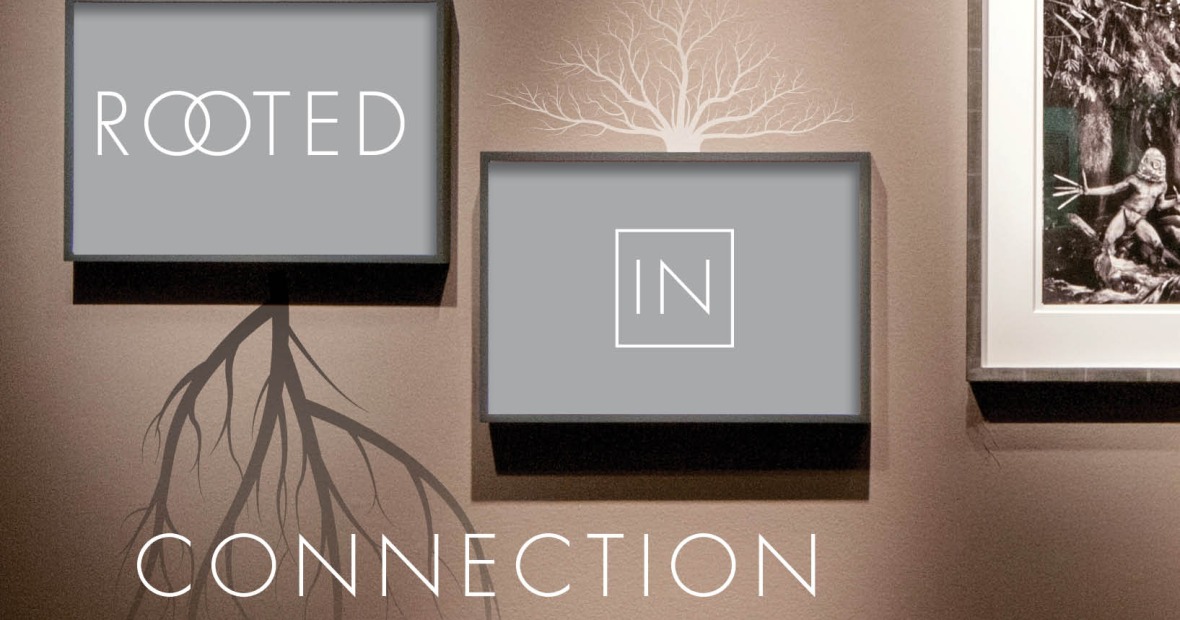
When Ella Barnett ’27 thinks about “Rhizomatic Intimacies,” the spring 2026 exhibition built around the photography collection of Grinnell College Trustee Keith Jantzen ’80 and his husband, Scott Beth, her first memory is not of the finished galleries at the Grinnell College Museum of Art.
Instead, she remembers a table covered with photographs and a room full of classmates trying to make sense of them.
The 12 students in the exhibition seminar class taught by Professor of Art History Michael “Mac” Mackenzie spent hours arranging and rearranging printed images, testing combinations, debating ideas, and searching for connections between works that, at first glance, seemed unrelated. In the process, they were also discovering how to work together.
“There was one day when we basically came up with all of the major groupings for the exhibit,” Barnett recalls. “We all had all the photographs printed out, and we were moving them around, trying out different combinations. We all really cared about this exhibit and had a lot of different ideas about it, but everyone wanted to be respectful and make this a collaborative effort.”
That afternoon around the table became a microcosm of the project itself. “Rhizomatic Intimacies” was never simply about hanging photographs on a museum wall. It was about building relationships — between artworks, between disciplines, and between the people who brought the exhibition to life.
Over the course of a semester, students traveled to California, stepped inside a private art collection, met gallery owners and museum professionals, debated curatorial decisions, wrote exhibition texts and catalog essays, and worked alongside museum staff to create a public exhibition from Jantzen and Beth’s collection. The result was more than a class assignment. It was a vivid example of the collaborative, experiential learning that defines a Grinnell education.
A Collection Becomes a Classroom
The project began several years ago, when Mackenzie visited Jantzen’s and Beth’s home in California and realized the possibilities hidden within the couple’s collection.
“The collection was so rich in possibilities,” Mackenzie says, “and the opportunity to work directly with collectors and with donors to the museum’s collection seemed like such a great chance for students to learn about the social and emotional bonds, the community, and the networks that artworks are a part of.”
When Mackenzie proposed building an exhibition seminar around the collection, Jantzen and Beth didn't hesitate.
“When Mac approached us and said, ‘I’m going to have a seminar where students focus on a collection and then create an exhibition — would you be willing to lend your collection for that?'” Jantzen recalls. “We said, ‘Absolutely.’”
For the couple, the idea embodied the kind of learning they have long supported at Grinnell.
“We felt like we were accomplishing multiple things,” Beth says. “It’s really great to share our art, and the academic programming — being able to meet with students and connect with them and be part of this seminar — was so fulfilling. It kind of checked all the boxes for us.”
Their involvement extended well beyond lending the photographs. They helped fund student travel, welcomed the class into their home, arranged visits to galleries and museums, and shared the personal stories behind works they had spent decades collecting.
Seeing Art Through Someone Else’s Eyes
Before the semester officially began, students traveled to California to experience the collection in the place where it actually lived, in Jantzen’s and Beth’s San Francisco home.
Rather than encountering the photographs in a gallery or a textbook, students found them integrated into everyday life.
For Neva Zamil ’27, that setting changed everything. “It was a very special experience to be trusted in that way,” Zamil says. “In many art settings there is a sense of distance. We’re not allowed to get that close to the artwork. But it’s so different when you’re in a situation where people are living with it, where it is part of their daily lives. Our first exposure to these works was not in an academic setting, it was on their walls and on their dining table.”
That experience helped shape the exhibition’s central theme: intimacy.
Princess Alexander ’25, another student in Mackenzie’s class, remembers noticing details that might have escaped them in a traditional museum setting. “We got to see how they displayed the works,” she says. “For example, they had mirrors positioned in front of some portraits, and we became interested in the idea of reflection. When we designed our exhibition, we wanted certain images to face one another, and that idea came directly from seeing how they displayed works in their own space.”
The trip also introduced students to the many careers that support the arts. Visits to San Francisco’s Fraenkel Gallery and conversations with curators, gallery staff, and collectors opened a window into a professional world many had never considered.
“The amount of different people in the art world that we got to meet was really valuable,” Barnett says. “Not just museum professionals, but people working in galleries, people working in more private collections — facets of the art world that aren’t always as immediately visible.”
For Jantzen, those experiences represent the very best of a Grinnell education. “This is a kind of experiential learning that I think is just unsurpassed,” he says.
Learning to Curate and Collaborate
Although Mackenzie created the framework for the seminar, the students themselves shaped the exhibition.
“All of the choices — the 38 photographs that were used in that exhibit — those were all specifically chosen by the students,” Jantzen says.
Reaching those decisions required patience and compromise. Every student arrived with strong ideas and different perspectives.
Eventually, the students stopped waiting for the professor to provide the answer and built one together.
“My favorite thing that happened in the class,” Mackenzie says, “was when, while I was trying to push them toward a certain decision-making process, they got frustrated and met on their own one day and came up with a whole conceptual framework — and even a title.
“That combination of the ideas of a rhizome and of intimacy came from them,” he adds. “That's a teacher’s dream.”
In botany, a rhizome is an underground root system connecting plants that may appear separate above the surface. The students embraced the idea as a way of thinking about the hidden relationships among artworks — and among the people creating the exhibition itself.
“We defined rhizome as essentially nonhierarchical,” Zamil says. “Something you can approach from any angle.”
Behind the Museum Walls
As the exhibition developed, students discovered that curating involves much more than selecting art.
They worked alongside museum staff, exhibition designers, registrars, editors, and publications specialists, learning firsthand how many people contribute to bringing an exhibition to life.
“It became a wonderful collaboration between the students and museum staff, with the students really taking the lead,” says Susan Baley, director of the Grinnell College Museum of Art.
Alexander recalls working directly with GCMoA’s Director of Exhibition Design Milton Severe to translate the class’ ideas into the physical realities of the gallery.
“He brought expertise about accessibility, viewing heights, spatial constraints, and visitor flow,” she says. “We had to give up some of our creative freedom because he understood what would actually work in the space.”
The experience changed the way she thought about museums.
“My biggest takeaway was understanding just how collaborative museum and gallery work really is, and how much happens behind the scenes.”
Students also encountered the practical complexities that visitors are rarely aware of — image rights, permissions, catalog production, and installation logistics.
“People often assume that because Keith and Scott own the photographs, they automatically have the right to reproduce them,” Baley says. “That’s not the case.”
The Grinnell Difference
The partnership and intense collaboration throughout the process of creating the exhibit had a lasting impact on everyone involved.
For Jantzen and Beth, seeing students engage so deeply with the collection revealed new perspectives on works they had lived with for years.
“The level of engagement and insight that they’ve shown is really astonishing,” Jantzen says. “It was very eye-opening to us to have other people look at what we’ve collected in a very focused way.”
Baley saw the same thing happen. “Some of the pairings the students created surprised Keith and Scott,” she says. “They would say, ‘I never thought about those works together in that way.’”
For Beth, that exchange became one of the project’s greatest rewards.
“It’s fabulous to meet these young, extremely bright people and to look at our collection in new ways through their eyes.”
The students describe the experience in much the same way.
“It gave a lot of autonomy to student voice in the process,” Zamil says.
Barnett believes opportunities like this are rare.
“This is an incredible opportunity that I don’t think many colleges would be able to offer,” she says, pointing to the chance to travel, collaborate, and learn directly from collectors and professionals.
And for Alexander, the project reinforced what makes Grinnell distinctive.
“I just feel very thankful,” she says. “Grinnell really is a hidden gem. You don’t necessarily expect all the opportunities and experiences that you’ll have.”
Long after the exhibition came down, what remains are the connections it created. Visitors to “Rhizomatic Intimacies” encountered photographs linked through unexpected relationships. Behind those walls, however, was an even larger network connecting students, faculty, alumni, collectors, museum professionals, and donors.
Like the rhizomes that inspired the exhibition’s title, those connections, while not always visible, are what continues to allow ideas and people to flourish and grow together.
“Curating Connection,” a short video featuring several of the student curators, Keith Jantzen, Scott Beth, and others involved in making this special exhibition possible, shares more about their experiences.
Originally published in the Summer 2026 issue of The Grinnell Magazine.