
shabab m. kabir and Rachel L. Rudacille Named Thomas J. Watson Fellows
The Watson Fellowship is a $40,000 one-year grant for purposeful, independent exploration outside the United States

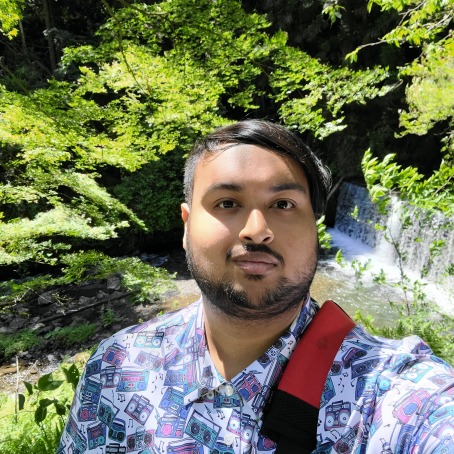
shabab m. kabir ’26 and Rachel L. Rudacille ’26 have been awarded Thomas J. Watson Fellowships for 2026–2027.
kabir and Rudacille were among 40 students selected nationwide from 155 finalists from 41 partner schools to receive the $40,000 fellowship stipend from the Thomas J. Watson Foundation. The fellowship program offers “college graduates of unusual promise a year of purposeful, independent exploration and international travel to enhance their capacity for resourcefulness, imagination, openness, and leadership and to foster their humane and effective participation in the world community.”
kabir’s project, Sonic Materiality & A Baul-Fakir’s Coloured Hearings, is centered on sonic materiality through listening, co-creating compositions, and musicking with communities across seven regions where sound is practice, not ornament. They plan to listen to the community and their soundscapes in the countries of Japan, Italy, Brazil, Zimbabwe, New Zealand, Iceland, and Indonesia.
“I am beyond excited,” said kabir. “Between thinking through my dreams and realities, through crossings with pluralversal worlds and soundscapes, I am dreaming wildly.”
Rudacille’s project, Community as a Catalyst for Climate Action, explores what allows communities to effectively organize for climate action and how communities enact climate change response and mitigation strategies. They plan to visit communities addressing sea level rise, uplifting indigenous knowledge, implementing climate mitigation strategies, and more, gaining an understanding of what community resilience looks like in action. Project countries include United Kingdom, Denmark, Kenya, Mozambique, and Kiribati.
“I am honored and thrilled to have been chosen as a Watson recipient,” said Rudacille. “I anticipate that my Watson journey will greatly broaden my understanding of the climate challenges that are faced globally and the multitude of ways that people organize to respond to and mitigate them.”
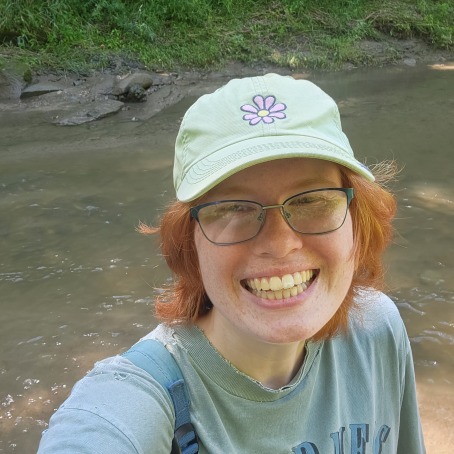
Rudacille continued, “Community has been the underpinning of my most meaningful and thought-provoking climate experiences, and I am eager to deepen my understanding of community and learn about unique approaches to addressing climate change in community as a Watson fellow.”
Grinnell has partnered with the Watson Fellowship Program since it was established in 1968. With the announcement of this year's recipients, 88 Grinnell students have been named Watson Fellows.
“The College wholeheartedly congratulates Rachel and shabab on their receiving Thomas J. Watson Fellowships and we look forward to following their journeys,” said Ann Landstrom, assistant dean and director of global fellowships and awards and the college’s Watson Fellowship advisor.
Rudacille, a physics major and environmental studies concentrator from Centerville, IA, has been a member of Citizens’ Climate Lobby (CCL) for the past two years, an organization that empowers individuals to lobby Congress for climate solutions. In this past year, they founded and lead a chapter of CCL in Grinnell, IA. Rudacille is a leader for food security efforts in Grinnell—connecting student volunteers with Food Recovery Network, stocking Drake Library’s food cupboard, and leading the development and recent opening of the Grinnell Community Fridge. The past four years they have worked with the Office of Civic Education and Innovation, in the Center for Careers, Life, and Service at Grinnell College.
They are a Science Community Leader, member of the Physics Student Educational Policy Committee, and co-leader of Gender Minorities in Physics (GMiP), where they have built community in the physics department leading mentor sessions and coordinating student attendance the past two years at the American Physical Society’s Conference for Undergraduate Women and Gender Minorities in Physics. They also held physics and energy summer research positions at Iowa State University, Binghamton University, and Grinnell College.
Rudacille co-organized two student-led Climate Change Community Discussions, events that bring diverse panelists from the Grinnell faculty and surrounding community together to center unique discussions about climate change and its implications in Iowa. Their leadership and public service commitments were recognized in April 2025 when they received a Truman Scholarship.
“I am incredibly impressed with Rachel’s leadership, integrity, and passion towards their academic and community commitments; with such a dedication to apply their deep learning to the challenges and joys of grassroots organizing in the climate space,” said Landstrom. “They genuinely invest their full self into what they care about, inspiring others to do the same.”
kabir, a QuestBridge National Match Scholar and independent major in mathematical physics and sonic materiality with a concentration in digital studies from Oklahoma City, OK, is a member of the Balinese Sound Ensemble, and has previously participated in other musical groups, including the Zimbabwean Mbira group and the Jazz Ensemble. Beyond these musical endeavors, they have served as a Community Advisor fostering an inclusive and supportive environment in the residence halls, student researcher in both physics and gender, women’s, and sexuality studies departments, and member of the Independent Major Student Educational Policy Committee.
kabir has an independent practice of music composition, sound artwork, and digital projects while also work experience in Grinnell College’s Immersive Experiences Lab. In addition, they have worked at three national laboratories, including Fermilab, Brookhaven, and Argonne national lab between quantum science to nanomaterials. kabir was a recipient of the prestigious Goldwater Scholarship in March 2025.
“shabab’s interest and training in both artistic and scientific fields is distinctive,” said Landstrom. “Their creative imagination and respectful presence will foster listening, mutual collaboration, and shared joy of soundscapes on their Watson journey.
Upon completion of their Watson years:
kabir will pursue a PhD in quantum science focused on quantum algorithms and quantum materials, and also cultivate a lifelong practice in sonic materiality as a composer creating mixed-media works and performance lectures with communities.
Rudacille will obtain a master’s degree in engineering and public policy, concentrating on renewable energy—working closely at the intersection of science and policy that furthers equitable access to clean energy.
The College appreciates the journeys proposed by all of the applicants in fall 2025. Other nominees included: Cornelia Di Gioia, history and music double major from Evanston, IL, “Wood that Sings”: the Culture of Worldwide Fiddles and Salif Sangare, sociology and studio art double major and film studies concentrator from Bronx, NY, Wearing Voices: Unraveling the Western Seam.
"The Watson application process transforms a person’s deepest interests into a project of purposeful independent exploration that will continue to be part of an applicant’s life forever,” said Landstrom.