
Summer Research Where Land Meets Water
Millie Leonard ’27 studies streamside microbes during Mentored Advanced Project (MAP)
Adam Sodders
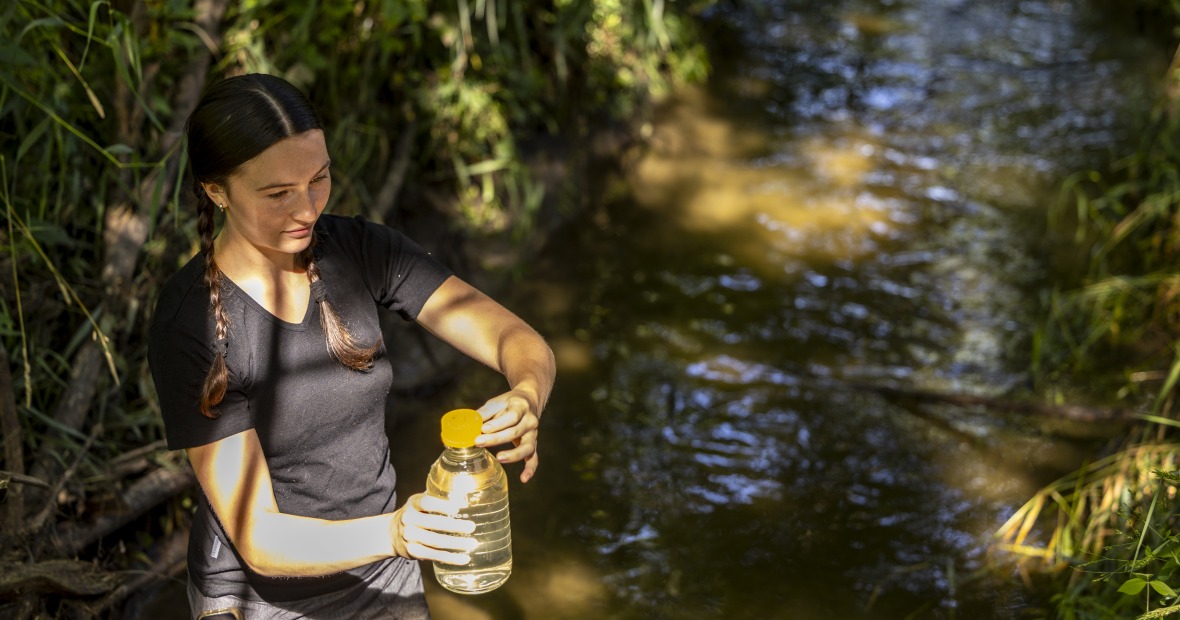
The waterways cutting across Iowa’s vast farmland create rich habitats for organisms of all sizes, and some of the most important ones can only be seen under a microscope. It was at the meeting point between land and streambank — which scientists call riparian buffer zones — that biology major Millie Leonard ’27 chose to concentrate her summer Mentored Advanced Project (MAP), where she studied soil microbes’ antibiotic resistance under different land use practices.
Getting to know the ecosystem
“I basically surveyed the composition of bacteria on soil from a Poweshiek County farm, which had hogs and corn, and compared that to samples from the CERA [Henry S. Conard Environmental Research Area],” Leonard said of her MAP. “I also took a sample from the neighboring waterway at each site.”
Getting enough high quality soil samples required an intentional approach.
“To make sure I had a very full picture of the bacteria living in the soils, I collected 10 samples from a variety of areas at each site, including near woody vegetation and in grass-dominated spots,” she said.
Armed with her samples, Leonard’s research continued at the lab. She said antibiotic resistance — where bacteria evolve to survive against natural and man-made antibodies —is of major interest in two career areas she’s considering: ecology and medical biology.
Findings and future work
Thanks to her thorough soil sampling, Leonard had plenty of data to sift through. So much, in fact, that she worked with professor of biology Shannon Hinsa-Leasure to extend her project into the fall semester. As her work continues, Leonard did have one finding from her analysis that she didn’t expect to see.
“My hypothesis was that there was going to be a higher number of both antibiotic-producing and antibiotic-resistant bacteria in the farmland samples,” she said. “What I actually found was there was more antibiotic resistance in the CERA buffer zone bacteria compared to the farm site. That really surprised me.”
Leonard said she hopes to get more answers this fall. Along with finishing soil sample analysis, she also plans to compare the soil microbes to those she finds in her stream water samples.
Enjoying the nitty-gritty
Leonard said her summer MAP let her apply what she had learned from previous courses, while exploring a topic of great importance across the biological sciences.
“Antibiotic resistance is something a lot of people are studying; it’s a huge, growing issue,” she said. One of the things we talked about with Professor Hinsa-Leasure is that some common, curable pathogens can become uncurable with antibiotic resistance.”
The MAP experience also allowed Leonard license to dive into the details of her research and grow her professional skills. It also offered an excellent opportunity to network with the experts in the Department of Biology.
“Doing research full-time looks much different than it does during a three-hour lab once a week,” said Hinsa-Leasure. “It takes planning, patience, and drive.”
Leonard appreciated having the support of Hinsa-Leasure and other faculty members throughout the summer. She also liked having the chance to connect with fellow biology students.
‘It was so fun to get to know some of my professors and grow my relationships with some of them,” Leonard said. “It was a great learning experience.”