
Who Shapes a Neighborhood?
Grinnell Students Explore the Human Side of Housing Change in Summer MAP
Housing affordability is often discussed through data, policy, and economics. But behind every housing debate are people whose experiences, memories, and connections to their neighborhoods influence how they view change.
This summer, students participating in a Mentored Advanced Project (MAP) with Assistant Professor of Political Science Andreas Jozwiak are exploring those human perspectives by interviewing longtime residents in Des Moines and Iowa City. Their research seeks to better understand how neighborhood experiences shape attitudes toward housing, development, and local political decision-making.
"This MAP grew out of a combination of my own previous research and observations of current debates over housing policy," Jozwiak said. "To some degree or another, the U.S. is experiencing a housing and specifically, a housing affordability crisis. We need to build our way out of this, but we often see that housing developments get slowed down at the local level, sometimes because of NIMBYism or the not-in-my-backyard effect — people are supportive of housing in the abstract, but find it difficult to accept in their own neighborhoods."
Rather than focusing solely on housing policy itself, the project asks a different question: How do people understand the places they call home?
Listening to Communities
With Grinnell located between Des Moines and Iowa City, students are able to conduct research in two communities with distinct histories and housing markets.
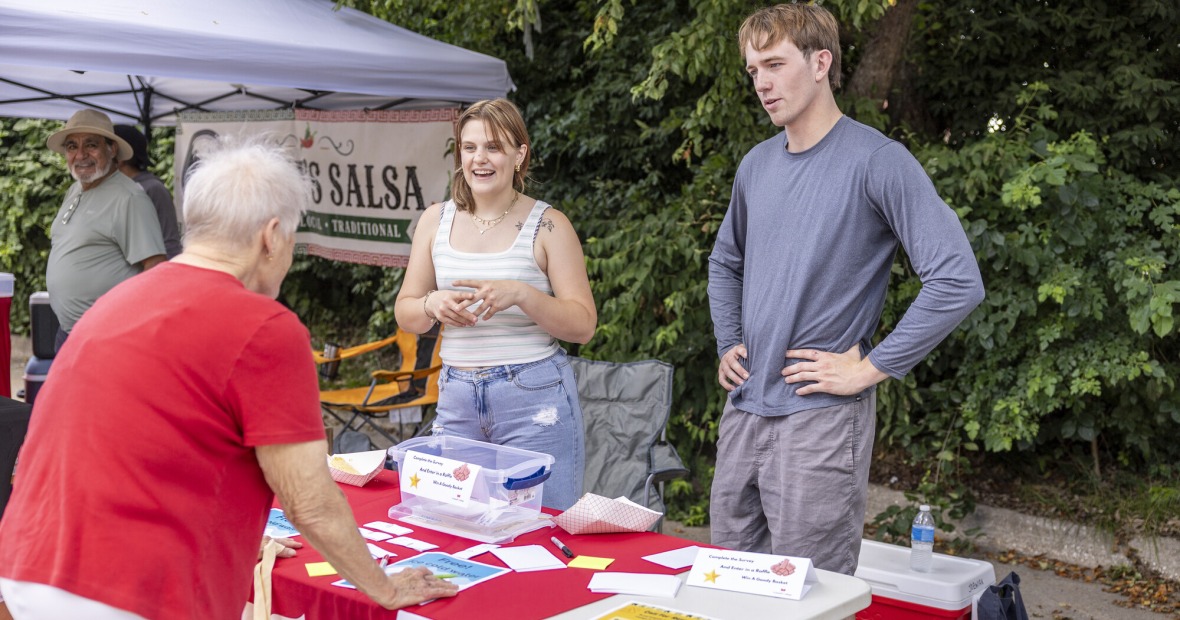
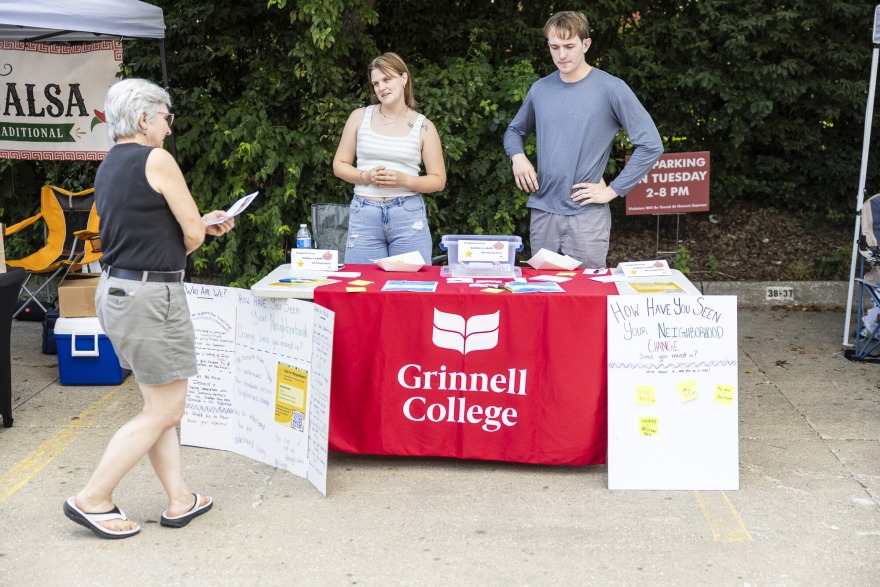
“Students are trying to listen to as many residents as possible,” Jozwiak said. “They're attending Farmers Markets, Neighborhood Association Meetings, and other community events to get people to talk about what they value in their neighborhoods, how they've noticed it change, and what they want local elected officials to do for their neighborhoods.”
“The students are working both in Des Moines and Iowa City, which have two rather distinct housing markets — Des Moines has many older, more established neighborhoods, while Iowa City is a quintessential large college town.”
For Lily Shoemaker '28, the project felt personal from the very beginning.
"This topic interested me because of how closely tied it was to my home," Shoemaker said. "As an Iowa student, it's not every summer that you see a research project which is about a city you already know so well, like Des Moines. The ability to talk with residents from these cities and further understand their experiences and emotions about living in Iowa was one I couldn't pass up."
She also found personal connections through many of the stories residents shared.
"Housing affordability and neighborhood changes is something my family has had to navigate throughout our time living here," she said. "The stories about the 2008 flood in Des Moines were so interesting for me to hear because they are the same floods me and my family experienced when I was a kid."
For Owen Hope '28, who grew up in the Des Moines area, conducting research in a familiar community offered another opportunity to see the city through a new lens.
“Growing up in the Des Moines area, I knew what could get them talking about their city. Their input on what was going on inside the city was valuable not only for the research, but for my own basis of knowledge about the city,” Hope said.
Research Beyond the Classroom
Shoemaker helped develop the survey used to collect data, recruited participants at the Beaverdale Farmers' Market, expanded outreach through social media, and explored how racial attitudes relate to perceptions of neighborhood change.
Along the way, she discovered just how deeply people identify with the places they live.
"A lot of the residents' connections to their neighborhoods run deeper than I expected," she said. "Even when prompted with hypothetical changes they didn't like the idea of leaving their community. Most of the residents seemed to perceive change more like an obstacle to overcome than a barrier to staying."
Many conversations left a lasting impression. "Stories about how the residents came to being in their neighborhoods definitely opened my eyes to how close these communities become," Shoemaker said.
Noah Smith '27 approached the project from a different angle, working with the Iowa City group and focusing specifically on the role politics can play in shaping attitudes toward housing.
“My specific focus within this project was on the impact of partisan affiliation and national political ideologies in the way housing preferences are formed, so our survey questions that aimed to understand that part of the question were also primarily designed by me,” Smith said.
Building Research and Communication Skills
While students are investigating timely public policy questions, they're also gaining practical experience in qualitative research and community engagement.
"We're really building research and communication skills," Jozwiak said. "We began the summer doing some readings and compiling literature, but quickly pivoted to developing interview questions and recruitment strategies."
Because interviews are built around conversation rather than surveys alone, students are learning to think on their feet while building trust with participants.
"I think the interpersonal nature of this type of research is particularly challenging, because students are having to think on their feet while making sure they collect data they need and maintaining rapport and relationships with the individuals they're talking to," Jozwiak said.
For Shoemaker, that growth has been especially meaningful.
Understanding the Stories Behind Policy
At its core, the project demonstrates that conversations about housing are ultimately conversations about people.
"Our personal experiences shape how we think about politics — and where, and how, we live is no exception," Jozwiak said. "It shapes what we think cities should do and offer in terms of urban services, but might also shape expectations about what the future of the neighborhood should look like."
By better understanding those experiences, researchers hope to gain insight into how communities respond to growth and change.
For Shoemaker, the project has reshaped how she thinks about her own community. "It has made me think more about the connectedness of my own community," she said. "I think that it is easy to get cynical about these ideas as they relate to politics. However, the conversation I was able to have showed me that many residents truly care most about their neighbors and their community."
For Smith, one of the clearest themes to emerge from conversations with residents was the importance of connection and belonging.
“One thing that was pretty ubiquitous across the respondent pool was that people desire community and social relationships. People want to live in a safe, connected, and friendly neighborhood that fosters real community and connection between people. Self-interest is the driving force for most decisions related to the home, but included in that self-interest is a desire for meaningful human connection,” Smith said.
"This experience has definitely been challenging for me as I have never been a huge fan of interviews but by engaging in these interviews for my projects, I have gotten much more comfortable with the skill."
The relationships students built extended beyond the formal interviews.
"Making connections with people at the farmers' market has easily been my favorite part of the experience," Shoemaker said.
This story is part of Grinnell College's summer experiential learning series. This year, the College is investing more than $1.2 million to support Mentored Advanced Projects (MAPs) and student internships, creating opportunities for students to pursue original research, creative scholarship, and hands-on learning on campus and around the world. Read more about Grinnell's investment in experiential learning.