
Working Toward Food Justice in Rural Communities
Through Grinnell’s Summer of Service, Sebastian Mrotzek ’28 is working alongside community partners to address food insecurity while exploring what it takes to create lasting change.
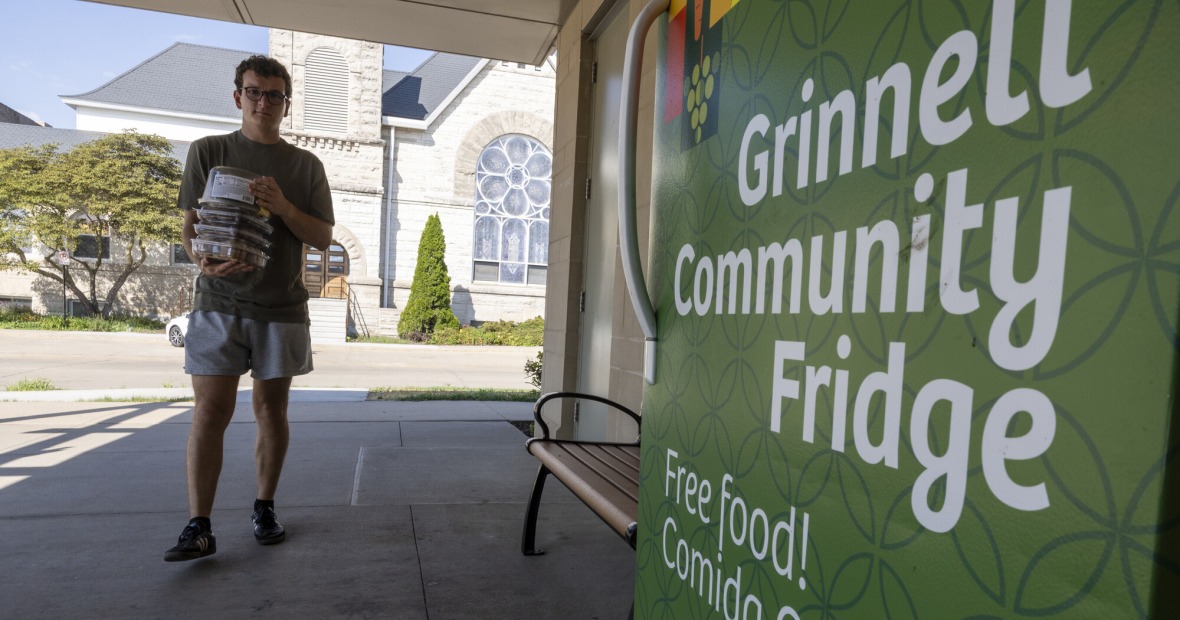
For Sebastian Mrotzek ’28, addressing hunger means thinking about both what a community needs today and what could make that need less common tomorrow.
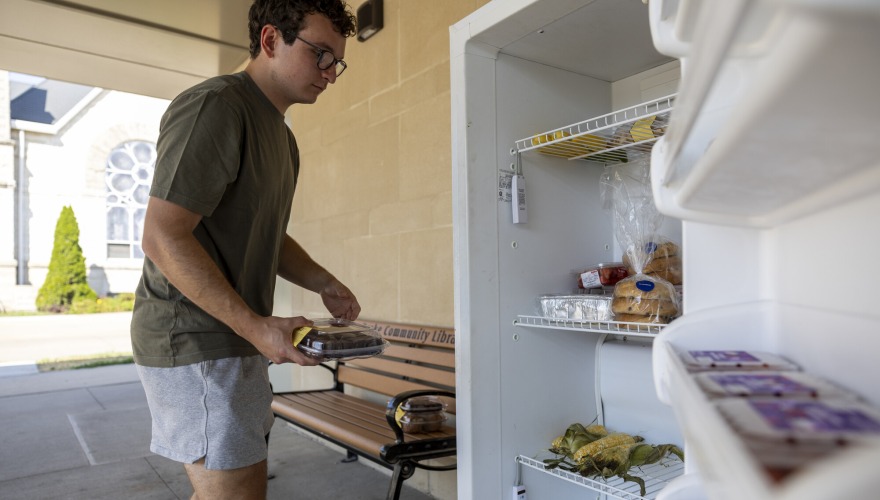
An economics major at Grinnell College, Mrotzek spent the summer working with local organizations focused on food access as part of the College’s Summer of Service program. His experience has taken him from stocking the community fridge at Drake Community Library and helping with community meals to volunteering with organizations working throughout Grinnell and Poweshiek County.
At the same time, he has been examining the larger systems that contribute to food insecurity and considering how communities can move beyond meeting immediate needs toward creating long-term change.
“In food access work, the short term is feeding people and the long term is creating the kind of systemic change where no one is hungry again,” Mrotzek said.
Connecting Service and Systems
That combination of hands-on service and deeper study is what initially drew Mrotzek to the Summer of Service.
Along with volunteering, Mrotzek is completing a Map the System project, which encourages students to look critically at a complex social issue, understand the people and organizations involved, and consider the structures that contribute to it.
“The unique model of the Food Access/Food Justice Summer of Service inspired me to apply,” he said. “You have the privilege of experiencing direct volunteer work while also doing a Map the System project.”
Throughout the summer, his weeks have blended the two approaches. He regularly picked up food and delivered it to the community fridge, spent time at the Grinnell Community Meal and volunteered at the Grinnell Empowerment Command Center. Other parts of his week were dedicated to reading, research and discussions with fellow Summer of Service students.
Those experiences gave him opportunities to take what he was observing in the community and consider it through a broader lens.
Food, Community and Connection
Working alongside different community organizations also helped Mrotzek see that successful food access efforts are about more than providing meals.
“I learned the importance of centering the community in your food access approach,” he said. “While each organization had a different approach to food access, they had one thing in common: community. Community is what makes their food access effective. It provides more than food — it provides a sense of belonging.”
He saw that connection especially clearly through the community meal.
“When someone has access to food, they are able to find community around their dinner table with their family and friends,” Mrotzek said. “The community meal allows people to find community again around the dinner table. They stay not for the food, but rather for the opportunity to enjoy it with someone else.”
Mrotzek was also struck by the network of organizations working to address food insecurity in the Grinnell area. Through efforts such as the Grinnell Food Coalition, local organizations can communicate, coordinate and learn from one another while serving community members.
For Mrotzek, understanding that network has been an important part of understanding food access in a rural community.
Building Trust Before Creating Change
Another important lesson for Mrotzek has been understanding that lasting change must be developed alongside the people it is intended to serve.
Throughout the summer, he has been encouraged to listen to community members, build relationships and better understand their experiences with food access before considering potential solutions.
“The goal was to co-create change,” Mrotzek said. “However, to co-create change, one must build trust in the community.”
That emphasis on listening and relationship-building has helped Mrotzek see food justice not simply as a problem to solve, but as work that requires meaningful community participation. By spending time with community members and the organizations that serve them, he has gained a better understanding of how trust can help shape solutions that reflect a community’s needs.
Looking Beyond Hunger
Ultimately, Mrotzek hopes his summer encourages others to think about food justice as something broader than providing food to someone who is hungry.
Emergency food programs play an essential role, he said, but his work has also pushed him to ask why people need those programs in the first place — and what changes could reduce that need.
“When people hear ‘food justice,’ I hope they remember that food insecurity is a systemic issue,” Mrotzek said. “The current emergency food system does an amazing job feeding people, but it doesn’t do a great job making sure people don’t have to get fed.”
For Mrotzek, that distinction has become central to his understanding of food justice: meeting people’s needs now while continuing to work toward a future in which fewer people experience hunger in the first place.