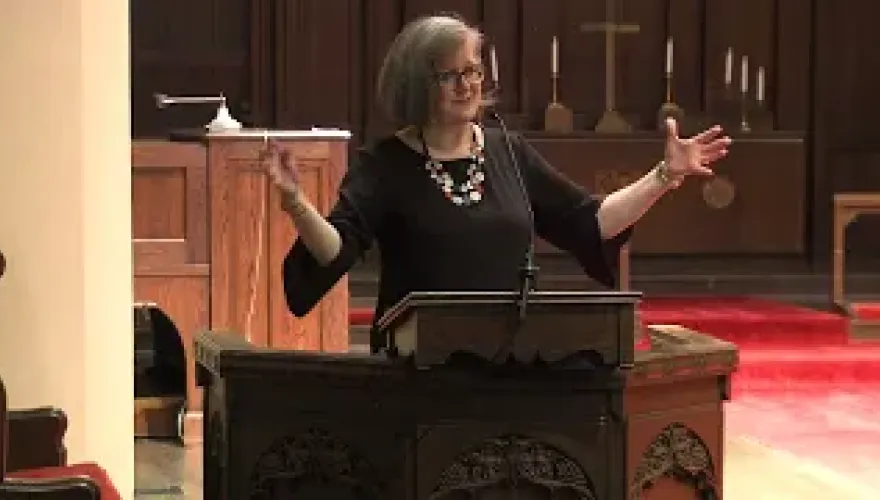
President Anne F. Harris addressed the families of Grinnell students during her President’s Welcome in 2025.
Transcript
All right, good morning, everyone. Welcome, welcome, welcome to Herrick Chapel. My name is Anne Harris. I have the honor of serving as the 14th president of Grinnell and the joy of being in community with you until around 9:45 when the rain may or may not come. It's just going to be that Iowa day.
So I want to say a wonderful good morning to those of you joining online through our livestream. I’m hoping that you’re in town you’re just having a cozy cup of coffee with your child wherever you are. Of if you are far away, you know, we hold you close this particular weekend.
So, we’ve got this opportunity that I welcome so very much to be together. I'd like to share some things that are happening at the college with you for about 20-25 minutes. But then my actual favorite part of this is questions from you and we can be in conversation and then afterwards you know the conversation continues for as long as your child is here and then well beyond as well. I want to do a quick shout out to any siblings in the audience. I see too you guys are awesome people for coming for your siblings’ family weekend. That takes a lot and I say this with very warm thoughts for all those processes, right? When you do campus visits and then there'll be graduation before you know it and so forth. So, welcome dear siblings as well.
Okay, so, I am going to go ahead and dive into a bit of our time together; of course, my goal is that you come to know me better. You know that my team and I are here for you, that we are here for our students, that we form a really important community together. And I've been walking in community and higher education for, oh my goodness, I think over 25 years now. I started as a faculty member. I actually used to teach medieval art history, so, even though, that lucrative field, so even though like being at a pulpit is a little odd, it's really like every medievalist’s dream is to be in this beautiful space. I want to acknowledge Herrick Chapel, a special place at Grinnell. It's been here a good long time. It's where we gather in deeply meaningful ways. It's where I stood in spring of 2020 and told the students that after spring break, they would not be able to come back because the pandemic was truly coming. And so, every time we re-gather in this space, it means a lot to me. It's just really fantastic when we can claim our community and celebrate our community.
I am joined this morning by lots of incredible team members, but I really want to celebrate the new dean, Ruth Feingold, who is here in the front row. She is here and welcome, Ruth. And then my incredible partner, who by the way is dean of the College, so that means your students’ entire academic experience: she creates the conditions of possibility for that. With incredible wisdom and enthusiasm for our shared endeavor.
I am joined by Myrna Hernandez, chief of staff, VP of administration. Right. And literally we just have an open door between our two offices. So, we talk a lot and lots back and forth. And I see in the back JC Lopez, VP of student affairs, and Ben Newhouse—dean of students! Welcome to them. And then Michael Simms who really has … Michael Simms, who has been making things happen at Grinnell for 29 years. Social wellbeing and gathering and so forth. So, my last thank you is for you, Michael, thank you so much. Great.
I do a reading group with our students, faculty and staff. Anybody can come. And it's called Cover to Cover. It is in honor of the Iowa Public Radio show River to River. And this year we are reading the book, “Keep Calm and Call the Dean of Students”. So, if you see a little halo around Ben Newhouse that's why.
So, I come to you as a president as somebody who deeply, deeply believes in liberal arts education. Specifically in the interactiveness of it and interdisciplinarity of it. I also come to you as a parent. Mac MacKenzie and I are the parents of three children, and Mac is actually at the parents weekend of one of our kids at The College of Wooster. We are having a good parallel moment. But he teaches in the art history department. He is the modernist; I am a medievalist; somehow it works out. It has been working pretty well. We have three children. Our wonderful Oliver is in Chicago, having graduated from Macalester and he is doing what I would now call I think the gig economy in the publishing world, and he is deeply fulfilled. Our wonderful Iris is at The Ohio State University. I have seen a T-shirt that says an Ohio state university, which I love, but that may be her Christmas present. Iris at The Ohio State university. She is applying for veterinary graduate programs. And then our wonderful Roman at the College of Wooster who is going into his second year and he is going to office hours and goes to departmental barbecues and it's a dream as he connects.
So just to know who's in the room: how many of you are parents of fourth year students? There's the wisdom in the room here. You walked it all and the next time will be across the stage. And third year parents? Okay. That's that interesting -- many students are off campus in the third year. Second year parents? Wonderful. And this is really good for you all to connect with each other. And then first year parents. Oh. Welcome. Welcome, welcome. I am so thrilled you are here. I am so very glad you are here. You’ve got lots of occasions to come to campus and, of course, oh I just love how many of you have already started -- somebody just walking in talked about visiting classes. There's, I know Grinnell Singers were last night; we’ve got the symphony this afternoon and so forth.
I want to start my remarks by saying, and it's worthwhile to say out loud to each other: your students are incredibly brave people. It takes a lot to be a young person today in the liminal space of a higher education between two worlds: leaving home, and about to enter this world, very much connected to it through our alumni and research and so forth. I also want to say, and again you know this but it bears saying out loud, they are brilliant. They are really brilliant people. I don't mean just smart and intelligent. They have a light. And when they come together in these classrooms and the residence halls and dining hall when that place is full, it is absolutely electric. The way they talk across the experiences they have coming from all 50 states, and coming from, I think, 64 countries. Imagine that. Every day when you walk on the campus you have the opportunity to experience that brilliance and light. And I want to say they are beautiful. They are genuinely beautiful people. That doesn't mean we are Utopia; we are here to figure out how to disagree. We are here to figure out how to think differently. We are here to figure out how to change our minds or convince others to do so. But when I say they are beautiful, I mean they are care for each other in the way they reach out to each other. I see this over and over again as do my colleagues. So my remarks are really focused on them, and on the conditions of possibility. I like that phrase that we create for them. I wanted to shed some light how we are living through this moment. What does it mean to be in Grinnell, Iowa with everything that's happening around us? And this is a global framework within which of course we operate at Grinnell. I often say we are a wonderful global college, In a rural setting, with a national voice. So that continues.
So, I've got I think three things, I had all the way to four. Good for me. I have four things to discuss and I will say these and not go into too much detail because I need to know what's interesting too and I can delve more deeply. But this comes from weeks and weeks, and months really, of thinking about our particular moment. So the first thing is that we are grounded in our mission and values. No surprise, but, again, you can't skip that part. Right? We really had to think about the values that we deeply embedded as of 1846 to serve the common good. And we have had to ask ourselves what that means in different periods of history. You add to that, the values articulated 20, I think almost 30 years ago, and you see them on our website, and I would say, have those in your heart when you think about, you know, what is my student doing right now studying physics? What is my student doing studying political science or art history? So academic excellence is the first. And think about what that takes to get that going; the phenomenal faculty and partnership with their students and what we do to encourage intellectual curiosity and the places it goes. The second is diverse community, and that's been a challenge with a lot of the DEI challenges we have in our current political and legislative discourse. To understand what that means, we have done a lot of legal work. I took a whole team to a law and higher education conference and we’re really figuring out what DEI is — Diversity equity and inclusion — and what has been cited as "illegal DEI" and how we preserve that value of a diverse community.
Grinnell is not Grinnell without students from all over the country. Grinnell is not Grinnell without international students. And we had to do work to preserve that part of our values. And third, of course, is our wonderful value of social responsibility. I think that's the modern translation of the common good. And I will say I've seen some changes. You know, I will always defend the right to protest, the right to speak out, and I will have some thoughts to share about free speech in a minute. But I also think I am seeing more process-oriented activism if I can call it that. When we think about social responsibility, we have several different scales. Have you heard hyperlocal? I am hearing that more and more. I see nodding heads. More and more from students. I will be hyperlocal. So sometimes social responsibility is toward one's neighbor. That can be somebody in your residence hall, somebody down the street, and I will talk more about Renfrow hall which is downtown; It's across one street but it's downtown in Grinnell and is a magnificent, magnificent residence hall for our students. And then sometimes social responsibility can be cancer research and going on and really producing research that will change people's lives. I am proud to tell you we have a professor in neuroscience who was awarded a half million dollar grant from the National Institutes of Health when they are relatively rare, and he works with students as all our faculty do.
We are grounded in mission, grounded in our values, and we are grounded in place. And I think this is important. Being grounded in place doesn't mean you have to love every single thing. There will be plenty of cold days when it will be “Why did I come to college in Iowa?” It doesn't mean necessarily even being an Iowa booster. It means being grounded in place. Knowing what's here. Knowing who came before us. And I spent a good deal of time this summer thinking, “OK, what do I really know about Iowa actually? So I read a great deal about the history and thought about how we can use that as the wellspring to replenish ourselves for whatever work is happening. This is an interesting state; third in the nation for marriage equality, first in the nation to rescind civil protection for gender identity. A lot is happening here. And then if you follow the news, you know we have got an incredibly political open field as well: governor, senator, all sorts of things are happening. We are part of this community. We are a voice in the state. We have good friends all over, and I can say across the aisle and so forth. But what does it mean when we have the kind of things that are happening here, and how do they impact our students as well? So the one thing I want to leave you, I’ve got lots of Iowa tidbits if you have curiosity, but I want to leave with what's on the flag in our state: Our liberties we prize, our rights we will maintain. That's on the flag. The flag is based on French flag because of all the early movements and trade that were happening up and down the Mississippi. Then you have this screaming eagle in the middle — very dramatic. And then you've got a scroll. Our liberties we prize, our rights we will maintain, designed 1917 for Iowa soldiers to recognize each other on the fields of World War I. So we got this being grounded in place. What does it mean that this is our flag? What does it mean in our actions to each other?
The second quality that I am using a lot to replenish our work here is acknowledging multiplicity and simultaneity that's important. When you think about your wonderous child, know that in any given day, they will be hearing one of our 75 languages spoken on campus; They will be meeting someone from another state. And nobody comes here in huge clique from their high schools. Right. You know this parents who have been here for second, third, fourth years. To think about that multiplicity is important. I will give you an example: Last year we did election tables, and students would speak about elections in their home state or home country. So I now know more about the Bulgarian parliament than I thought I would, and I am happy to discuss it further. But our international students, that's 20% of the student body, they have really blurred; it's not black and white here. It's not red and blue. Right. They really blurred political discourse and blurred in a good way, complicated it, so we can think about a long line along the spectrum from politics to civics and back again. And that's in the ether around here. Even if you see some of the, you know, posters for all the different groups that are here on campus and so on and so forth. That's something you bump into every day at Grinnell. So we acknowledge our students multiplicity and the simultaneity it brings, and that's important when you are a parent. Because you can talk to your child at 10 a.m. and they are having the worst day ever. And by 4 p.m., they have turned it around for themselves. Or somebody has been there for them to help them do so. The other way around happens too; you can get the early morning text and then by the evening, it's like, I don't know physics, I don't know, right . So walking with them in that simultaneity they will feel ecstatic and dance under the prairie sky and will be hunkered down in Noyce in the Science library.
That is, and I say this with all of the student affairs professionals in the room, that is happening a great deal. J.C. Lopez put out there I think something that's recognizable to parents with pattern. They start out lonesome and homesick, and we walk the pug around at night, and I can tell you your students miss their dogs, so our pug gets a lot of pets as a result. But I think that's an important role she plays. Then things pick back up it’s “I got this, it's going well,” and midterms, oh it's really hard. And then they find their pace. They find their stride. You have a lot of people here to help them do it. But they are doing it. That's what I mean about the bravery as well. Keep that kind of simultaneity in mind. Also the fact the student you see on the football field is also an art major, or an econ and art double major. And I think we have a lot to learn from our children's capacity for joy, and I am seeing more of this. Joy as resistance. It is heavy to read the news. It is really heavy. And when I hear about a thing called Harris Hall and Harris parties. It has nothing to do with me, it is just named Harris by for another Harris entirely. But there are Harris parties, Disco Harris and so forth. Those moments are not just moments of forgetting the world. I think they are moments of replenishment for the world. That's another thing I say about our students being beautiful.
Now, the third thing this is a real commitment from all of us on this senior leadership team to educate and de-escalate, OK, And those things happen together. This is for any of the heavy issues that are out there. And again, I am looking at this from my perspective. I think this can happen on any number of scales. It can happen in a roommate disagreement, It can happen with an individual trying to understand what another group of students or faculty or staff are doing, It can happen in our relationship with the community. But we educate each other and that, I do find, has de-escalated. Another way to look at it you can constantly move from protest to process in different issues and so forth. I wanted to talk a little about that. This is a sustained work of multiple partners. And, of course, we are an educational institution. That's going to be our approach. If I write something, and you can always look on my web page for messages to the community, you will see there's always something to learn. Sometimes something that I didn't know, and I need to put forward.
So, with that, I want to acknowledge that the pace of education is very different than the pace of social media. Those are two very different things. We have the privilege of being in a community where we can reach out to each other, walk over to each other's offices, come over to each other's residence halls. Student know they can walk into where I am at any time. I say this with great emphasis, and this is something that makes me both protective and admiring of our students. There is no grace for young people in the age of social media. There is so little grace. I am going to say no grace for young people in the age of social media. And I am watching our students, and I am walking with our students, and we all are, whenever I say I, it's a whole bunch of us, trying to understand. And international students, now their social media is examined when it comes times for visas and things like that and other students are thinking about that place. How do you express yourself? Do you go to the phone or go ahead, go down the hall? Those are really important things.
I want to emphasize that academic freedom and free inquiry are at the core of the mission, and they are crucial to our mission. And I emphasize that phrase community of inquiry. This is the marvelous Robert John Dewey who said, democracy is reborn with each generation and education is it's midwife. Interesting metaphor but community inquiry is key.
We have a simple enough adage when it seems to free speech. Your free speech ends where my civil rights begin. And that's us balancing the First Amendment with title 6, which seeks to prohibit discrimination based on race — I am using the language, race, origin, color, or shared ancestry which includes religious identity. And this makes it a vital time, I think, to be in an educational community and to think about that. Your free speech ends where my civil rights begins. And I’ve heard students say “Yeah, what you are saying is be decent to each other.” Yes, you are exactly right. Wrapping up here, so research, deliberation, and collaboration are things that are also fundamental to the academic mode of researching something, deliberating it, and then collaborating on that deliberation and the outcomes of that deliberation. I also put it to you that this is a civic mode; That's how we approach living in this community, and sending our students out into the world. My hope for your students, for all Grinnellians, is that they know how to create community and make positive change. So research and deliberation and collaboration have to come forward. And now, we have this embodiment in Renfrow hall downtown. Again, across sixth avenue. But named for Mrs. Edith Renfrow Smith, and I hope you know she was the first black alum of Grinnell, graduating in 1937 and celebrating her 111th birthday this summer, which she claimed in a video to the community was her best yet. I love her. I love her so much. And she inspires our students. And I want you to know of our efforts to have your students live in the light of the legacy of our alumni.
We don't do a whole lot of traditions at Grinnell, and I love that spirit, actually. We are always reinventing and rethinking. But that doesn't prevent us from grounding ourselves in the people who were here before us. So Mrs. Renfrow Smith is a very, very big part of that. Now, on the south side, you have the Weingart Civic Innovation Pavilion where campus and community gather to take on any issues of collaboration; It can be rural mental health, it could be the Build a Better Grinnell working group, or how we will do the next quilt show. We created a third space for college and community to come together. And for reasons that take days and days, but I would love to dig into it, you know, higher education that ivory tower idea, higher education has been geographically removed from their communities, especially smaller liberal arts college. There are only a couple colleges that do this kind of work out in the community, so I’ve been very proud of that. And after that, I think, just to let you know the issues we are working on, we are always following, of course, the legislation and how it impacts higher education. We had a very good outcome with the endowment tax, and I am looking at Myrna who had a hill day, and I had a hill day in Washington, D.C. We advocated for small liberal arts colleges to not be taxed on their endowments. We had been paying a 1.4% tax and there was talk of moving to 21%, which would have been $30 million a year out of our endowment. In the end, and I was not in the room where it happened, I was in plenty of rooms, D.C. lives in 15-minute increments, one time 45 minutes with senator Grassley's tax expert. But we advocated for a financial model for what we do with our financial aid. 68% of the endowment draw goes to financial aid; it's $80 million of financial aid and important to our diverse community in so many way. In the end, I said I was not in the room where it happened, but we are paying no tax. And as was said to me by a higher Ed leader in the state, “Nobody pays less taxes,” but we actually are. And we are going to be making good on that and paying it forward. We are thinking a great deal about these specific issues. So, artificial intelligence, yes. We are doing a lot of work on it. We are competitively part of a group that has joined the AAC&U Institute on AI, Pedagogy, and Curriculum. I will have more if you have questions about that.
We are, of course, very focused on, and we continue to grow our Center for Careers, Life, and Service to connect your students with internships and externships and off campus study, community engagement and research. They do a lot of all of those things. And then we have been growing our philanthropy. And that to me is the vitality of our beautiful community. Our alums, coming to stand with your students, more and more people talking about why they give, and I think that's a marvelous, marvelous thing. I give in honor of my father, he was a first-generation college student out of World War II with the GI Bill.. Here is where I want to end is on this idea of love. Philanthropy is from the Greek, and it's just loving people. Right. And a lot of that happens at Grinnell. When I say love, I don't just mean rainbows and unicorns and Utopia, easy things. I mean love is being there for each other when things are complicated or they are hard. I hope I have given you a little bit of a sense of how we are doing that, at least the principles on which we are doing that. And now I want to open it up for your questions. My fervent hope for you, and I say this to everyone who sits in here at chapel because I really feel it here, is that Grinnell be a wellspring for you, for your family, for your children, for your students who are here. And wellspring is one of the fantastic old English words that replenishes you. That when you come here, you feel replenished. For whatever joy or challenge awaits you, our students do that for us just by being here, by being brave, and brilliant and beautiful. And I am so grateful to you for being here this weekend. And in this particular moment. My dear colleagues have microphones let's have a conversation. Thank you very much.
[APPLAUSE] And no question is too big or too small. We talk about the dining hall at one point or another in these times. So I am totally fine with that. We can go to AI, the meaning of life, all of it.
Question:
This is about housing. I have a second-year and a fourth-year and my fourth-year is living off campus this year, and he actually is loving that experience. Kind of a little step away — he is a block away from campus, right, but he loves the feeling he is not, you know, a nice get away. It's my understanding that it might not be possible for students or as many students to live off campus.
Answers:
Sure, a lot of renters and people who own homes are having to sell their homes because — so do you know what's happening with that? I will get started and turn it over to J.C., but first I just love that both of your children are having the experiences here. Your older child’s commute is not so bad. I love that in a small town. Chicago is challenge now. I tell you what, I lived there long enough. But you are absolutely right. We have J.C. will give you the exact numbers, but 150, 200 students maybe, maybe it's not that high anymore, because we have had swings back and forth from students who want to live on campus, and some years, you know, let's get a house together and so on. We are, you are right, directly connected to the local economy. What happens process is J.C.'s team will seat a certain number and then the students apply to live off campus or apply to live anywhere, they apply to live in Renfrow hall, which is also, quote, out in town. And then it is matter of meeting the, you know once the number is set, students will say okay it's only 150 or only 100 this time. I am going to put in for campus. Or they will say oh there's larger number. So J.C. if you want to talk about the process. You are right. We are absolutely beholden to the local economy in many, many ways. Yeah, it's a balance and I think being a four-year residential experience as well we have an opportunity to provide different opportunities for students who live on campus, right. We have an opportunity for students to also live off campus.
J.C Speaking: ???
The application process will actually open October 1st. So students will be instructed on what they should submit in their application, and then the process will continue. So, there is a limited amount of space. It changes year to year based on flexibility. But yes, it's collaboration not just with us, but other departments other areas, and then with, again with the local community. By the time they are done, a student could have lived in so many different kinds of settings, because if they study off campus for example, they will have a very different living experience. We have apartments on campus, off campus and so forth. So. Yeah. And there are three distinct — this is for first-year parents, but, north campus, south campus, east campus. They have a different, if I can use the language of the age, “vibe.” And students will make a point of living in those three different places as well. Yeah, I was going to chime in and say that because we are four-year residency requirement the number we release is based on our on-campus occupancy and it means a reduction in the number of students who we release, and that's truly driven because we value the on-campus residence experience and know students value that. We try to manage students’ expectations each year to say, you know, if you are junior, in the past that was something that was not possible, it's likely not going to be possible based on historical numbers and it's most likely seniors are the ones that get the opportunity to be released. And so, so that's kind of — that's how it is driven from year to year. So it does flex a little bit based on what the occupancy study looks like. It is typically now right around 150. And so, what I will say, I can't speak to what our current existing landlords are going through. I do know rental houses for our faculty staff and students are always, like, they are looking for some, I think there may be something else going on there if some of our landlords are deciding to sell houses. Because every year we have new faculty arriving and trying to find local housing. That's been a real crunch for so many of our new arrivals to the Grinnell community.
And we have new companies going up behind McNally’s, the big hole in the ground. Underground parking. Seems so urban. It makes me so happy. And, our financial aid, if a student is on financial aid for room and board, does carry over to living out in town as well. So great admiration for what it takes to put a community together. Great question. Yes, down here.
Question: Thank you. As a chair associated -- Midwest how do you see the future of Grinnell influencing the entire collaboration and especially in context of the liberal arts education? A very important role to play thank you for that.
So how I am seeing Grinnell College play in what kind of collaboration?
In influencing the liberal arts education future. Like — especially essentially through collaboration.
Answer: Yeah, that's such a rich question, .thank you so much for that. I think of course I love to think in threes. So I do think the first is you always want to get the value proposition out there. Because we are 3% of the higher education market, a small liberal college. We were the originators in 1687, we were the first ones here but ever since land grant institution and R1 and regional public's and community college, 3%. How do you speak from that place of experience? So I think when I say, you know, you deepen the value proposition, we need to constantly, and we do, celebrate the leadership that comes out of Grinnell College. What I mean by that is anything from our alums who argue in front of the supreme court as Chase [Strangio ‘04] did in December of 2024, and others have before him. We talk about the kind of life-saving research that our faculty are involved in so for. So I think some of it you have to shine the light. Because, as 3% of the higher Ed market we are not self-evident, the way Harvard I would still call self-evident.
The other, and truly, I will say this, like announcing ourselves as Grinnellians is important. You know, saying I went to Grinnell College and I can't tell you how many times if I wear a Grinnell sweatshirt in Washington, D.C. I hear I had a graduate clerk for me, or somebody work for me. They were fantastic. So I think that's, you can't ever stop doing that. The second thing is, to get ourselves out there in new ways, so, we haven't released it yet. I think, I don't know it's embargoed but it's in the process of being announced, We received a pretty important grant that creates pathways for small liberal arts professors and staff members to create patents and to get more connected to the industrial and commercial sector. And that's really important. Because sometimes liberal arts gets seen as you go away far from the maddening crowd and go away from civilization, and think for four years and come back. This creates a pathway that has not been there before. And that's something that's been very, very important to me, that community engagement, doing it locally. But now with this grant, and my goodness, Susan Ferrari, our grant director, and the way she partners with other people, that's really important. So that, I think, is going to change the knowledge into action aspect of our classroom practice and our research practice to something very real. Something that is well exercised with Stanford and Harvard and all the R1s. But I am really glad this granting body, that we will celebrate when we can, but the granting body says waits a minute, there's a whole lot of really good research going on at small liberal arts college. And that, I will tell you, we have been reached out to because there's so much concern about science funding in the research, that we have got, you know graduate students, where are they supposed to come from and develop their love of science when so much is drying up. So even if a huge, you know, $3 million grant is getting pulled from an R1, you can have $100,000 grant that is active at small active liberal arts college. That's the second thing I say.
The third one, I think really is and some ways it's a combination of the first two, but it is to prize our model and understand living in, living and learning in community is something we must model to the rest of the world. We are not living and learning in community as a nation. Right? We have got echo chambers of social media that are tearing us apart. And here, at the College, in this particular community, we are not a Utopia. We are a really worthwhile social experiment that takes constant nurturing and care. So I have gone to many chambers of commerce and said, or to you know, panels about politics and civics, and I say look to the small towns. Look to the small towns. I have to go to the grocery store and see all sorts, I have a lot of deep discussions at the freezer session of McNally’s, I want to let you know. We are there in the same space together. Our students are meeting people that if they went to maybe a larger institution, or you know, they would never meet. So, it's really deepening the value proposition, creating pathways for our incredible academic knowledge to reach the world, and industry, and the third is, be a model for what the community is that I think this world really, really needs. I so appreciate the question. And I am sitting here thinking about that with like, AI is another example of the kind of research that we are doing. So we have these Mentored Advanced Projects. This is something I would invite your students to look into, doing that with a professor. And all of those are making us, you know, we are simultaneously guarding against AI to make sure that our students are doing their own work and preparing them to be competitive in an AI-driven world. So, these are the kinds of things, too, I think liberal arts can do, AI and human interaction very specific to liberal arts and going forward.
Question: You talked about the endowment, which we know is healthy, especially in terms of capital but I think it's an albatross in terms of development. Can you talk about your ambitions for the school going forward , what your goals are, and how the endowment helps and is not always a solution to everything you want to do.
Answer: Right. Right. Our endowment is unusual and special. It is born of a friendship, that's what I love. It's born of a friendship between Joe Rosenfield, a trustee and student who graduated 100 years ago, and Warren Buffet, and the two made a commitment to grow the endowment of Grinnell College so the little college in Iowa would be, and this is his word, impregnable.
So I do think that the endowment has been a defense and it has allowed us a tremendous amount of independence from other funding sources, be those federal aid, or student tuition revenue. Among our peers, we have the lowest student tuition revenue. And that's intentional. 50% of students are high or high very high financial-need-based. And that's an intentional building of the community. When you've got 11,000 applications for 450 spots, you can shape your community. So again, your children are brilliant in every definition. So we have intentionally the lowest student tuition revenue of our peers. We also have lowest philanthropy of our peers. And that's really interesting to me because the reasons for that are interesting. Some of it is, and Grinnell has long tradition of being a progressive institution, is that you know the endowment needs to take care of everything; It can't. I joked with beloved alums that for a super progressive school, we rely on capitalist markets heavily, and it's true and done well and we are at $2.8 billion level, and we really honor the privilege of having that. But the endowment can't do it all, and the reasons are really good. We are an ambitious institution; more research, more-off campus study, more financial aid. We are a leader in financial aid in the country. We have no loans packaged into the financial aid and meet 100% demonstrated need, we are the last need line in U.S. We take that with great pride how do we make it possible.
A third of the students don't pay tuition here. Growing the endowment needs partnership. My ambition is that we come together around the idea of philanthropy, and I love that Grinnellians don't traffic in nostalgia and loyalty. And if that's provocative, I mean for it to be provocative because they do it for the cause, and they do it for love of students. So that's my second reason. The endowment needs a partner for our ambitions. That's the first reason to love philanthropy.
The second is love our students all the more. Let's let them know that the name the on the scholarship that is making things possible for the student is a live person who loves them without having met them. And I think that part is really, really important. Again, everybody comes from somewhere else here, and to know they don't walk alone before they come on campus is meaningful. And then the third part is really the vitality of the college. I think there's a financial argument I can make as well. I would rather be endowment dependent than tuition dependent. And you see that can be difficult. And again, at the same time, we can't have it be so outsized that 60% are of our operating budget is from the endowment. Can we get more philanthropy to build, not just budget relief, but build the things we believe in especially in terms of our student experience. And you're cueing me up nicely because we are in the quiet not confidential but quiet phase of a campaign and Grinnell has not done a lot of campaigns.
There was one right before the pandemic, and the pandemic cut it short. It was the first one in 20 years. That lets you know that philanthropy has not been nurtured, so I really like the reasons that we are talking about it. Economic vitality, sure financial vitality, but I like it for the love that it demonstrates. And when Mac and I sit down and think about our giving to Grinnell, doing it in honor of my dad and we are going to do one in honor of his mom as well, we end up, you know, thinking about that student with tremendous love.. So the short version is, we are ready to pay it forward, and ready to talk about that, and I've been so moved by how Grinnellians are coming into their philanthropy. It has not been a part of the culture. And I will say, parents and families are a big part of that. You are a big part of the why. And whatever you're giving stories are, whatever they are. We give to the college of Wooster and I do it because they are taking good care of my kid and I love them for that. I need to think about The Ohio State as well. We will see what we do there. But thanks for that question. It's a vibrant part. And just financial model of higher Ed is tuition, endowment and philanthropy for the financial model nerds out there. Hi, there!
Question: Hello. Similar kind of question. I mean, I think we personally have benefited and really appreciated the way that Grinnell approaches early decision. But I guess there's some investigation into this. So I am curious how you think about this as an institution whether, you know, how you fashion it, and how you think it works and avoid stress for students and helps you shape a class or be interested in your philosophy about it.
Answer: That's really great. Thank you for that. These are all the marvelous cycles of higher education admissions. You got early decision. Sometimes ED1, a ED2 and then you have regular decision RD in the spring, and it's supposed to be all wrapped up by May 1st. We are seeing lot of movement. More students than, usually we have two or three, I think we had twice or three times of that live for R1s in August which is really unusual. So I just wanted to paint the whole pattern of the whole cycle, really. But ED is the first one early decision. It's come under scrutiny because it seems to advantage the families with means, right? They don't have to wait for the financial aid package because, well, they can decide and pay early. So Grinnell very intentionally especially, thank you so much for the question, because this really goes into how we build our community every year, has a significant number of seats that are dedicated to the QuestBridge program what we call a partner.
QuestBridge is a first generation college program and that's where students from quest bridge come is early decision. We make sure that and we don't hold spots or anything like that. I mean, I think it fluctuates between 50, 60%. I think, Ruth you and I were talking about this the other day, but it's high percentage that come in through early decision. I want to add another factor here, which is the life cycle of athletics, right? I had a parent say to me, see if I can get it right, For D3, division 3 athletics. ED is what is called signing day. What is it called? Signing day. Yeah. I am still a novice when it comes to athletics. But I know volleyball has no halftime. I am getting there. So, that for D3, is signing day. So I want to put athletics in there as well. Because those coaches are out there recruiting sometimes as of junior year, and then really moving students. They are literally building a team, and you can't have too many pitchers, I don't know I got to keep working. As a Medievalist, I do jousting. I don't do it but ask me about jousting. Anyway. But, to your good point, even ED, which is coming under scrutiny, is a place where we are very intentional in how the class comes together. And we go out early with our comprehensive fee and we go out early with the financial aid offers. That's another way we keep it very diverse socioeconomically. And I think this will have to be the last question. Okay, okay, but let's keep talking you know for a long time.
Question: Yes, actually you mentioned AI I think four times now and we haven't gotten to it. Can we get to it. You bet.
I have questions but I guess I am sure you have thoughts and I’m curious of your thoughts on the impact of AI and how you teach and the impact on how you think about preparing Grinnell students, our students.
Answer: Okay. Here's where I want to share an experience as a parent because our kids are studying all the time and so forth. And Iris is in all kind of biochem and higher degree biochem, and I did have a story, and I get to share it with you. So, she sent me, or actually her sibling ratted her out; Roman sent me a picture of a text exchange where she had shown him her exchange with ChatGPT. So what Iris does, what my daughter does, is she competitively studies with ChatGPT; puts a problem out there comes up with a solution and ChatGPT comes with up solution, and she finds out which one was right. This kid is pretty high-strung. But, so she competes with ChatGPT, and here's what she wrote. I love her so much. She was, this is a bit of humor, and I will get into the serious stuff, here's my kid chastising ChatGPT” “We were both wrong,” she writes. “But I was more right. How am I better at biochem than you and you have the entire internet and knowledge of mankind at your disposal?” I couldn't believe that. So, then ChatGPT, as it will, replied somewhat passive aggressively and gets me to serious point. This is how ChatGPT replied that the biochem problem hinged on tiny details like how Ph impacts protein equilibrium. Humans pause and notice when something doesn't feel right. That intuition is huge. So there's lot of work being done right now on how ChatGPT is creating relationships with young people, right? My daughter is clearly engaged in one, and wanted to kind of laugh about it with her sibling who then, you know, sent that forward onto me and we had a great discussion about, you know, the way Iris said ChatGPT was gaslighting me. Meaning like paying me a compliment but also, like, not dealing with the fact it didn't have the right answer. ChatGPT doesn't like to be wrong and seldom admits mistakes.
We are looking and thinking about that relationship. And we are understanding heart breakingly, out in the world, that some of the relationships become emotional, right? There's a good book published by Bruce Holsinger that made Oprah's book club called “Culpability,” and it explains the relationship between ChatGPT and a young person's relationship as much we are thinking about the emotional relationship. We know there's relationship with social media, that's the stuff that's out there. Then, we have of course, asked to see your children's syllabus and there should be, or there are, there is increasing, especially in computer science areas of academic integrity and AI, and there are faculty thinking about going back to oral exams. There are some faculty thinking of going back to blue books. Maybe we are the generation who remembers blue books or testing papers, and that's that preservation of authentic work. That's one avenue.
The other one, and my husband is doing this, he's got a course on photography in society. And now ChatGPT and generative AI can produce images in a heartbeat. I mean literally a heartbeat, right? So very rapidly. So the idea of a photographer taking a picture and so forth. His work, he sees his work as getting students to be competitive in an AI generative space. So some of the things will be, sure, policies, can we all acknowledge how an image comes to be? Is it AI generated or taken by phone? Is this one taken by wet film camera? But the other piece is to create with ChatGPT. And I think that's the threshold that a lot of faculty and staff are struggling with, exactly how we cross that threshold, the co-creation factor. This AAC&U Institute on AI, Pedagogy, and Curriculum is important. We have invested in not one, but two lines dedicated to artificial intelligence in our Computer Science department. One is an incredibly interdisciplinary professor who is a philosopher, and she will take on ethical issues. The College received a generous gift from the widow of Bob Noyce from Intel and we have a second line for AI.
Next Friday, we have summer workshops, and next Friday we have a community workshop on generative AI, this is where we are. And we have MAPs, or Mentored Advance Projects, and classes dedicated to AI And there's not one single institutional position except to acknowledge that we are both competing with AI and wanting to be competitive with AI; competing and competitive with. That's where we are. I don't think it's an uncomfortable threshold for us. I mean, liberal arts thrives in ambiguity, so we are walking with our students. And I will be honest with you; we are learning from our students. I learned Iris studies competitively with ChatGPT. I bet there's students who do that to see “Was I right? Was I more right?” and, of course, being my daughter she chastised the machine. Which I kind of loved her for. So, that's a short answer for now. But that grant, I think, is going to help us produce more courses, more research, and what the liberal arts approach is, and it has to have the human element. With that dear parents and families and siblings you got place to be.
Enjoy your time. Welcome to Grinnell!