

The Grinnell College Endowment
The Grinnell College endowment fuels academic excellence and ensures exceptional access and opportunity for today’s Grinnellians and for future generations.
The endowment is Grinnell College’s largest and most permanent source of resources, fueling the College’s mission and values. It fuels academic excellence, activates hands-on educational experiences, and ensures that students from all financial backgrounds graduate with less debt and more freedom to determine what comes next.
The endowment is made up of funds donated by individual alums, parents, and friends of the College as well as organizations with the intention that the principal is invested to provide ongoing support the College’s mission and purpose. The endowment was created when, in 1846, Trustee James J. Hill ceremoniously laid a silver dollar before those assembled and sounded a call to action that created Grinnell College.
Today, the endowment’s investment performance, prudent spending practices, and the generosity of thousands of donors enable its growth. As the endowment compounds over time, it carries forward the intent of every donor and ensures that future generations of Grinnellians will benefit from the College’s distinctive education in the liberal arts and sciences.
Endowment Impact
Funds in the endowment are invested and a portion of the earnings each year are used to support the College and its mission.

How Grinnell's Budget is Funded
Sixty percent ($115.4 million) of Grinnell College's annual budget comes from distribution of endowment earnings, while 32% ($58.9 million) comes from net student revenue (tuition and fees net of financial aid). The remaining 7% ($12.4 million) comes from gifts, grants, and other sources.

How Grinnell's Budget is Spent
Sixty percent ($111 million) of the annual endowment distribution goes to personnel (faculty and staff salaries) and 27% supports academic programs and utilities that support students and the College's mission. Of the remainder, 7% ($12.7 million) goes to debt service) and 6% ($10.2) million goes to the College's reserves, which ensure that the College has funding for planned and unexpected expenses.
About the Endowment
Unrestricted endowment funds may be used for general operations of the College. Restricted funds are used in accordance with each gift agreement, which reflect the purposes designated by the donor of each fund. The endowment is made up of nearly 700 distinct fund accounts, enabling the College to track earnings from restricted funds and ensure that they are spent in a manner consistent with the donor’s original intention.
The endowment is a permanent source of ongoing budget support for Grinnell. Each year, cash distributions are made accordance with policies set by the Board of Trustees and provide the vast majority of Grinnell’s financial aid and operating budgets. Endowment Performance
Investment Strategy
Grinnell’s investment strategy is designed to achieve strong risk-adjusted returns over a multi-year horizon rather than maximizing returns in any single year. Investment income has historically been particularly important in the growth of Grinnell’s resources.
| Annualized Rate of Return | 3 Year | 5 Year | 10 Year |
|---|---|---|---|
| June 30, 2026 | 14.0% | 6.3% | 11.3% |
Grinnell College achieved a 20.7% investment return for the fiscal year ended June 30, 2026, net of all internal and external investment costs. The endowment closed the year with a market value of $3.3 billion, up $483.0 million from a year earlier, reflecting strong investment performance and $26.7 million in gifts to the endowment.

Read more about the 2025-26 results.
Annual Support to the College
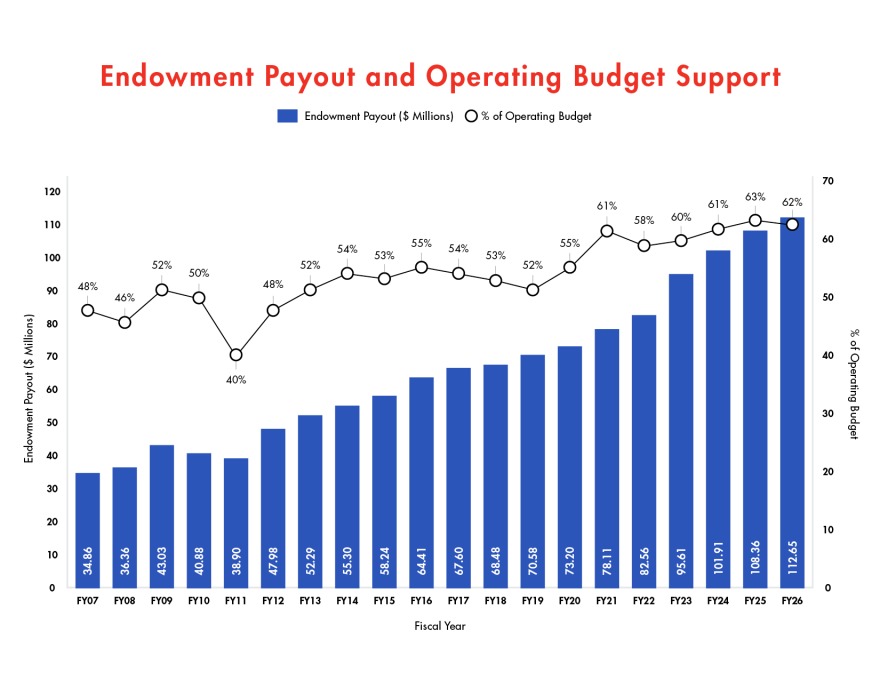
To calculate the annual payout, the College uses a hybrid formula that blends the prior year's distribution, increased at a fixed rate, with a spending rate applied to the endowment's trailing 12-quarter average market value. As a result, a strong year like fiscal 2026 raises spending gradually over several years rather than all at once. This approach keeps support for the College stable through market cycles and preserves the endowment's purchasing power for future Grinnellians. Over the past decade, the endowment has generated more than $2.5 billion in investment gains and provided nearly $1.0 billion in support of the College’s mission.
Investment Policy
The Investment Policy is set by the Grinnell College Board of Trustees with specific oversight by Exit 182 Group, LLC.
Consistent with the endowment’s objective is to support Grinnell College students, faculty, and staff in the present and the future, portfolio investments are well diversified across asset classes to enhance potential returns across a wider range of scenarios and reduce downside volatility. However, given a primary objective of maintaining real purchasing power over multi-year periods, the College expects that the endowment will maintain a bias toward equity investments (and asset classes with equity-like characteristics), which have higher long term expected returns, and lower exposure to asset classes offering fixed rates of return or current income. Further, the College believes that active management, which seeks to exploit market inefficiencies, can be additive to investment returns, particularly in nontraditional markets and strategies. Additionally, the Endowment’s long term investment horizon allows for the inclusion of illiquid asset classes and strategies that offer higher potential returns.
Recognizing the importance of environmental, social, and governance (ESG) factors and Diversity, Equity, and Inclusion (DE&I) factors to the long-term financial performance of business enterprises, investments and investment managers are evaluated with consideration for ESG and DE&I risk, opportunity, and impact.
Frequently Asked Questions
Grinnell College’s endowment, like other college and university endowments, is a collection of funds that supports students and faculty, as well as Grinnell’s educational mission. Endowment funds are essential to Grinnell’s financial sustainability, meaning that investments are designed to be sustainable over the long term. Every contribution to the endowment creates a fiduciary relationship between the donor and the College; managing the endowment requires detailed record keeping and careful stewardship.
The Board of Trustees has ultimate fiduciary responsibility for the endowment. Direct responsibility for the endowment’s investment policy is delegated to Exit 182, LLC (The Investment Committee), while retaining oversight through routine reporting and general policies.
Exit 182 Group, LLC (the Investment Committee) is responsible for maintaining a policy of prudent investment in stocks, bonds, real assets, non-marketable securities such as private placements and limited partnerships, and other similar financial instruments, interests and/or securities, subject to the approval of the Board of Trustees.
The Investment Policy for the Grinnell College Endowment is set by the Grinnell College Board of Trustees with specific oversight by Exit 182 Group, LLC.
The Grinnell College Investment Office team carries out the investment strategy established by Exit 182, LLC (the Board of Trustees Investment Committee), subject to approval of the Board of Trustees. Reporting both the Board of Directors of Exit 182 and the President of the College, the Chief Investment Officer and the Investment team implement the investment policy and investment sub-policies of the College.
The Trustees of Grinnell College are fiduciaries of the endowment, legally required to act in the best interest of the College and to act as prudent investors when managing the funds.
Fiduciary, which comes from the Latin fidere – to trust – means that board members, as stewards of public trust, must act for the good of the organization rather than for the benefit of themselves. Fiduciary duty requires board members to stay objective, responsible, honest, trustworthy, and efficient. They are expected to exercise reasonable care in all decision-making and avoid placing the institution under unnecessary risk. It also means board members ensure the programs align with the mission and that the impact of said programs is measured and reasonable.
The Trustees of Grinnell College maintain a written Conflict of Interest Policy, which shall be reviewed and signed by all Trustees annually. The policy protects Grinnell College’s financial integrity and ensures that all fiduciary duties are conducted in a manner consistent with Grinnell’s standards and mission. Members of the Board of Trustees, of Exit 182, LLC, the College’s officers and leadership are subject to the policy.
Two ways. First, through generous gifts from Grinnell’s alumni and friends. Second, through investment returns – income and appreciation of the various investments held by the endowment.
In the majority of cases, when a donor establishes an endowed fund, they make an initial gift. That original donation is invested and the resulting income is used to support a purpose that the donor designates. This designation is specified in an agreement between the donor and the College.
Spending the initial investment itself (or spending for a purpose other than that specified by the donor or donors) is illegal. The rules for when and how non-profit organizations like Grinnell may invest and spend the income from endowed funds come from a federal law called the Uniform Prudent Management of Institutional Funds Act, which was passed by Congress in 2006 and adopted in Iowa as Iowa Code 540A.103.
There are two classifications for endowment funds. Unrestricted funds may be used for any purpose that supports the mission and strategic goals of Grinnell College. Restricted funds must be used for the purpose specified by the original donor of the funds.
Many of the smaller funds that make up the Endowment each have specific restrictions on what they can be used for. That’s why investment returns and interest are so important – the original gift value of each endowed fund given to Grinnell (the "principal" of the gift) can’t be spent because they are meant to provide income “in perpetuity” (that’s forever).
Grinnell College’s Endowment Spending Policy establishes the rules for spending from the endowment to balance today’s needs with those of future generations of students. It provides support for current operations while safeguarding the long-term purchasing power of the endowment. It also provides documentation of compliance with applicable laws regarding the management of institutional funds. Grinnell College’s Endowment Spending Policy establishes the rules for spending from the endowment to balance today’s needs with those of future generations of students. It provides support for current operations while safeguarding the long-term purchasing power of the endowment. It also provides documentation of compliance with applicable laws regarding the management of institutional funds. The Board of Trustees monitors and approves the annual distribution.
To calculate the annual distribution, the College uses a hybrid formula that blends the prior year's distribution, increased at a fixed rate, with a spending rate applied to the endowment's trailing 12-quarter average market value. As a result, a strong year like fiscal 2026 raises spending gradually over several years rather than all at once. This approach keeps support for the College stable through market cycles and preserves the endowment's purchasing power for future Grinnellians.
For many reasons. The Endowment is not a big savings account that the College can use to pay for things – that $2.7 billion in market value is what generates the income that funds 60% of Grinnell’s operating budget each year. And even that income can’t be used for just any part of the budget -- in fact, the College is not free to use all of the investment income as it sees fit.
In most years, Grinnell’s annual payout from the Endowment exceeds what is added through investment returns and philanthropic gifts combined. The resulting is an annual Net Flow Rate (how funds move in and out of the endowment) of -3.5% in recent years. This means that based on the current annual payout to support operations, Grinnell spends half of the value of the Endowment every twelve years – and it’s not being replaced at the same rate. When market returns are average and Grinnell’s annual philanthropy total is less than average – as they have been since the pandemic – the Endowment can’t keep up. In fact, Grinnell is at the bottom of its peers in terms of its Endowment’s Net Flow Rate.
At Grinnell College, intergenerational equity is the principle of balancing the immediate financial needs of current students with the long-term purchasing power of the endowment for future generations.
Formally codified by the Grinnell College Board of Trustees, this principle dictates how the Grinnell navigates its endowment dependency while safeguarding its mission, including the need-blind admission policy for U.S. students and commitment to meeting 100% of demonstrated financial aid without requiring student loans.
As part of the Board’s fiduciary duty, the Investment Committee of the Board of Trustees (Exit 182, LLC), the Investment Office and the endowment’s fund managers actively seek opportunities to earn higher returns on the endowment than that provided by the financial markets overall. How the endowment is invested, therefore, is the “intellectual property” created by the investment office and investment committee to generate the highest possible returns for the benefit of current and future Grinnell students.
In most cases, the legal documents and contracts governing the College’s investments include confidentiality requirements that prohibit the members of the investment office, administration, or the College’s trustees from disclosing the names of the investment managers in the endowment or details of the underlying investments. Additionally, competition for access to the top performing investment managers is fierce. Disclosing specific strategies and investments would undermine Grinnell’s ability to access top performing investment managers (or allow other institutions to copy Grinnell’s portfolio strategy), which works directly against the College’s long-term interest of generating the income needed
The Trustees of Grinnell College established a formal policy outlining the requirements for proposals to divest from particular investments and the circumstances under which divestment decisions are made. Learn more: Grinnell College Divestment Sub-Policy