
From the Archives: A Victory That Made History
Tim Schmitt
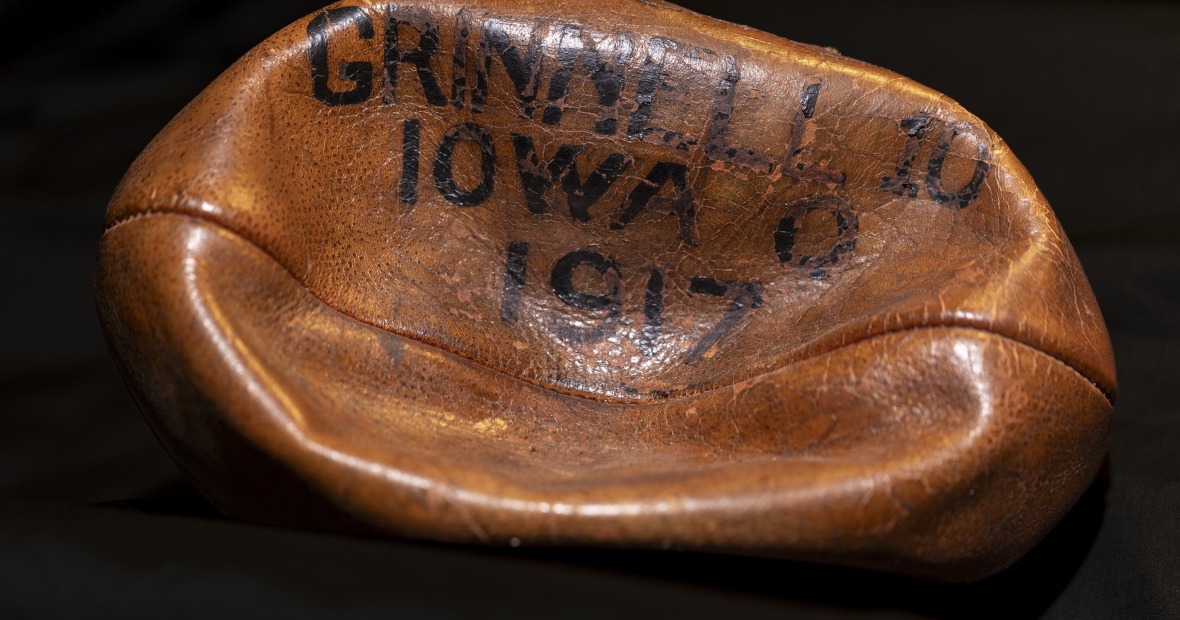
The football preserved in Special Collections & Archives in the basement of Burling Library has seen better days. Its leather exterior is worn, and it has long since lost its air. But this battle-worn ball carries the story of one of the most memorable victories in Grinnell College athletics.
On Oct. 20, 1917, Grinnell defeated the University of Iowa 10-0 in Iowa City, ending a football rivalry that had begun nearly three decades earlier. It was the final meeting between the two schools.
The rivalry dates to Nov. 16, 1889, when Grinnell, then known as Iowa College, defeated Iowa 24-0 in what is recognized as the first intercollegiate football game played west of the Mississippi River. Grinnell won three more times in the early years of the rivalry, defeating Iowa in 1890, 1891 and 1893. The teams also played to a 5-5 tie in 1898. Iowa eventually took control of the series, winning six consecutive games before the 1917 matchup.
Though the Grinnell team entered the game undefeated and unscored upon, for the season, the win was especially meaningful since Grinnell had fallen to Iowa in each of its previous six meet ups. The Pioneers (an informal moniker until 1919) went on to complete an 8-0 season, making the victory over Iowa a defining moment in a remarkable year.
But the victory was also more than a milestone on the gridiron. It was a moment of pride for the College community, including Grinnellians serving in the military during World War I.
A connection to Grinnellians at war
The United States had entered World War I just months earlier, and the war was very much a part of campus life. Students and faculty were organizing relief efforts, military training was taking place on campus, and Grinnellians were serving in the armed forces.
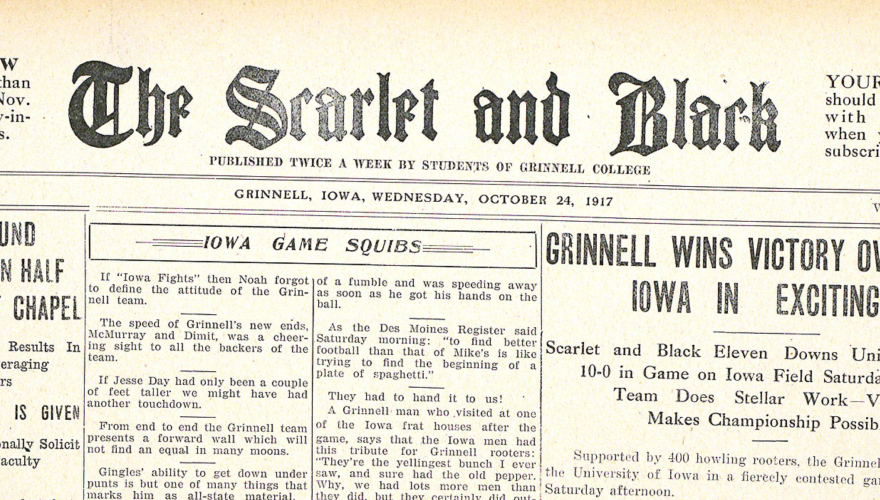
Among them were men stationed at Camp Cody in New Mexico, where soldiers were training for possible deployment to the Western Front in France. They were following the football team's progress from afar and wanted to know how the Pioneers fared against Iowa.
A report in the Oct. 20, 1917, edition of the Scarlet & Black noted that the soldiers had sent a telegram to the College requesting results from the game: “Send results to us immediately of Iowa-Grinnell game.”
Ralph Moorhead from the class of 1918 agreed to serve as a special messenger, spreading the news of the game throughout the camp to everyone from Grinnell.
The victory provided a welcome source of pride and connection for Grinnellians far from campus. Though a football game was small in comparison to the life-and-death struggles taking place in Europe, the soldiers’ interest demonstrated how deeply their ties to the College remained.
A piece of Grinnell history
Today, the football in the Grinnell archives is more than a reminder of a 10-0 victory or an undefeated season. It represents a moment when players, students, faculty, and alumni serving far from home shared in a common sense of pride.
It also marks the end of a rivalry that began with a historic first in college football. Preserved for more than a century, the worn and deflated ball connects today's Grinnell community with the people and experiences that shaped the College in 1917.