
Bringing Language to Life
Peer-led learning through the Alternate Language Study Option (ALSO) opens doors to culture, identity, and connection beyond the traditional classroom.
Tim Schmitt
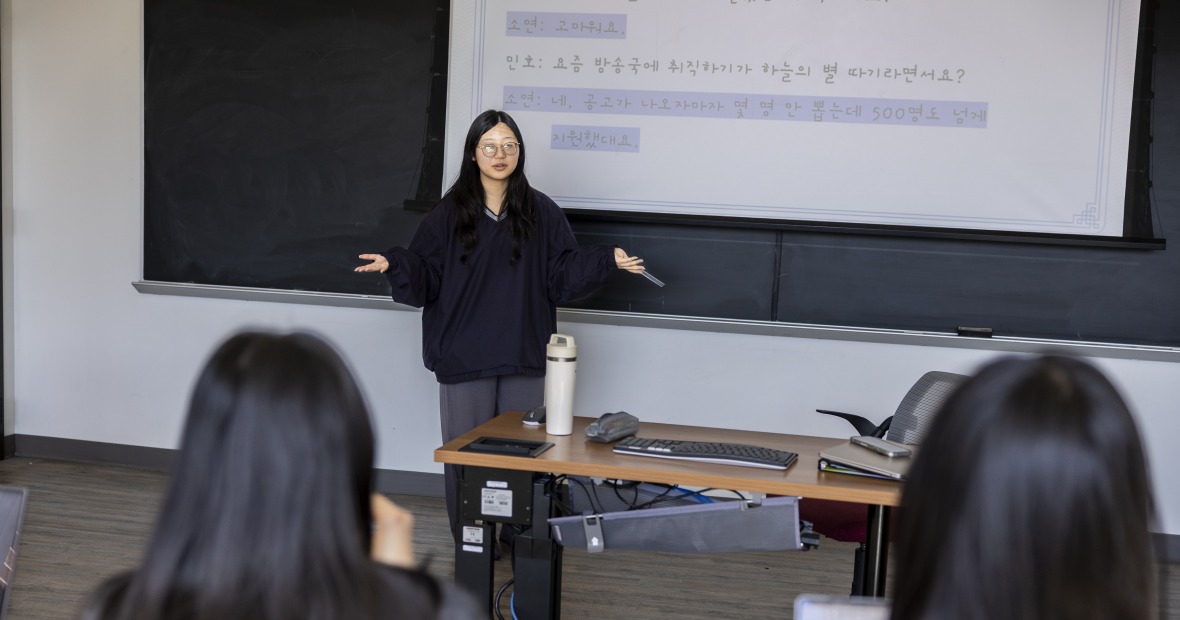
The first time Sethu Mnguni ’26 heard a classmate greet her in isiZulu outside the classroom, she didn’t expect how much it would mean.
“It brightens my day every time,” she says.
For Mnguni, an economics and Spanish major with a neuroscience concentration from Johannesburg, South Africa, those moments are why she joined Grinnell College’s Alternate Language Study Option (ALSO) program. As both a tutor in isiZulu and a student learning Brazilian Portuguese, she’s found a space where language transcends mere vocabulary and encourages connection, identity, and community.
Learning (and Teaching) What Matters
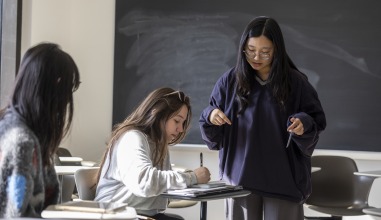
At many colleges, language study is limited to what’s listed in the catalog. At Grinnell, ALSO opens the door to something more personal.
Through the program, students study languages not offered in traditional departments—everything from Korean and Urdu to Modern Greek and Brazilian Portuguese. The structure is intentionally flexible and allows students to follow a guided curriculum while meeting regularly in small groups to practice speaking with peer tutors who are native or near-native speakers.
“It is a self-instructed language learning program that combines independent learning with regular conversational practice,” says Anastasia Izmaylova, director of the Center for Languages and Intercultural Communication.
But what makes ALSO distinctive isn’t just the range of languages, it’s who’s leading the classroom.
“Any language is possible if there is a student who is a native or near-native speaker willing to teach,” Izmaylova explains.
That model gives students like Mnguni the chance to step into teaching roles while sharing something deeply personal.
“I started as a tutor with the hope of sharing aspects of my culture on campus,” she says. “I’m the only South African international student here, so it felt important.”
At the same time, ALSO gave her space to be a learner, too. “I always wanted to learn Brazilian Portuguese and thought it would be interesting to hear the differences between Brazilian and Mozambican Portuguese, which I am more familiar with, given it is a neighboring country,” she says. “I figured, if not now, then when?”
Language Through Lived Experience
In Mnguni’s isiZulu sessions, language and culture are inseparable.
“If we’re talking about going to a game or a concert, I’ll bring in examples from South Africa — teams, artists, phrases supporters might use,” she says. “Sometimes I show short videos so students can see it in context.”
The result is a classroom that feels less like a lecture and more like a conversation shaped by real experiences and shared curiosity.
“I believe this approach works because many students want to communicate in real-life, informal situations,” Mnguni says. “It also allows tutors to incorporate their own stories and experiences into the lessons, which makes it more personal.”
Small class sizes make that even more effective. Mnguni can adapt lessons on the fly, responding to student questions and interests in ways that aren’t always possible in larger courses.
That responsiveness is by design. ALSO prioritizes communication over perfection, encouraging students to take risks, make mistakes, and grow more confident over time.
A Different Kind of Classroom
For students, the benefits are immediate and often unexpected.
The lower credit load and flexible format make it easier to explore a new language without overloading a schedule. For some, it’s a way to prepare for study abroad. For others, it’s about connecting to heritage or exploring a new interest.
“One of the biggest benefits is the opportunity to study less commonly taught languages tied to students’ personal or academic goals,” Izmaylova says.
Just as important is the environment itself. ALSO courses are collaborative, low-pressure, and driven by student motivation.
Rosy Bang ’26, who tutors Korean in the program, sees that dynamic play out every semester.
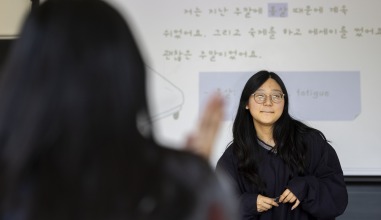
“Students come in with different reasons for learning,” she says. “Some love Korean media, others are interested in travel or culture, and there are Korean American students who want to connect to their Korean heritage, so I try to incorporate all those interests into what we do.”
Like Mnguni, Bang focuses on conversation and interaction, creating a space where students feel comfortable speaking, even when they’re still figuring things out.
“I’ve had students become close friends through ALSO,” she says. “That sense of community is a big part of it.”
Growth on Both Sides
While students gain language skills, tutors gain something just as valuable: the chance to teach, lead, and reflect. For Mnguni, that meant thinking differently about a language she’s spoken her entire life.
“I had not considered how to teach isiZulu outside of a South African context,” she says. “Doing so challenged me in a really positive way.”
She meets regularly with Izmaylova and other tutors to share strategies and refine their approach, building skills that extend well beyond the classroom.
And then there are the moments that remind her why it matters. “I love seeing the ‘aha’ moments,” she says. “And the discussions that come from that are some of my favorite parts.”
Building Community, One Conversation at a Time
With a history dating back to the early 1980s, ALSO continues to evolve with each new group of students, each new language, and each new story brought into the classroom.
But the impact of ALSO doesn’t stop when class ends. It shows up in greetings exchanged across campus, in friendships formed between classmates, and in shared experiences that bring language to life, like cooking together in the Marcus Family Global Kitchen or continuing conversations long after a lesson ends.
For Mnguni, those everyday interactions have been especially meaningful.
“I missed conversing in my home languages (isiZulu and isiXhosa) in person at Grinnell," she says. “ALSO created a space for that.”
This student-driven, globally minded space — rooted in lived experience — reflects Grinnell’s commitment to creating connections building community. It starts small, often with just a greeting or a quick conversation. But those moments stay with you, says Mnguni, especially when you are far from home.