
From Grinnell to Iowa’s Food and Farm System
The Coffee with the College conversation explored how experiential learning, environmental studies, and community partnerships connect students to Iowa’s agricultural landscape.
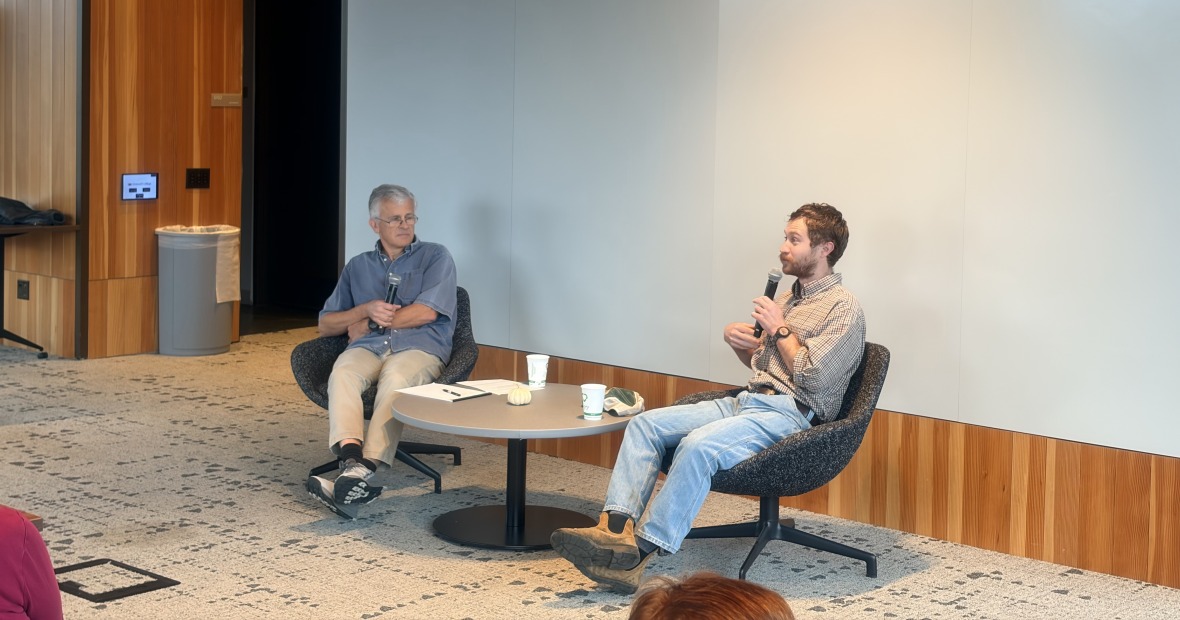
For Grinnell College alum Tommy Hexter ’21, a curiosity about Iowa agriculture that began during his first year on campus has grown into a career dedicated to strengthening the state’s food systems.
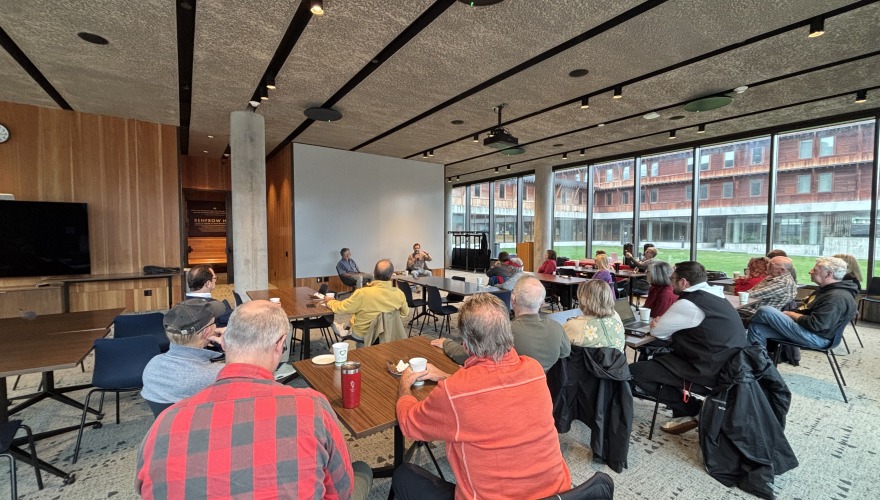
On Friday, Oct. 30, Hexter returned to campus for a Coffee with the College conversation with Peter Jacobson, professor of biology and chair of the Environmental Studies Department. Together, they explored how Grinnell College can continue connecting students with Iowa’s farmers, agricultural communities, and natural landscapes through hands-on learning, research, and community partnerships.
Finding a Passion for Agriculture at Grinnell
Growing up in Virginia, Hexter experienced a different agricultural landscape than the one surrounding Grinnell. When he arrived at the College in 2017, Iowa’s expansive corn and soybean fields sparked questions about how food is produced, distributed, and connected to local communities.
Those questions soon became opportunities for learning and engagement.
As a first-year student, Hexter helped establish the Grinnell College Farmhouse, a student-led residential community focused on growing food and connecting students through agriculture. He also became involved with the Iowa Farmers Union and local environmental organizations.
A course titled Culture and Agriculture, taught by retired anthropology professor John Andelson, further shaped his interests. Hexter later worked with Andelson to research how Grinnell College Dining Services sourced food from local farms, introducing him to the challenges and opportunities of regional food distribution.
"Being here at Grinnell College was such an opportunity to engage students in these questions of what is this food system," Hexter said.
That experience helped launch a career in agriculture and food systems. Hexter went on to lead Grinnell Farm to Table, serve as a Poweshiek Soil and Water Conservation District commissioner, and work as policy director for the Iowa Farmers Union. Today, he serves as executive director of the Iowa Food System Coalition, a partnership of approximately 65 organizations working to strengthen Iowa’s food system.
Learning Beyond the Classroom
Throughout the conversation, Hexter and Jacobson emphasized the value of connecting classroom learning with experiences in the surrounding community.
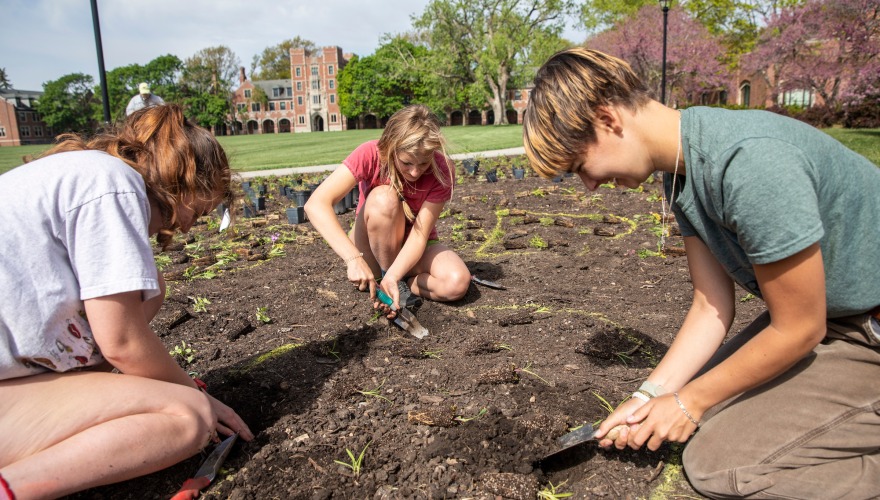
Hexter recalled helping lead the student initiative Too Much Grass, which brought students together to establish native prairie plantings on campus. The project involved approximately 150 students who helped remove sod, prepare the soil, and plant native species.
"I think these opportunities to get students outside, their hands in the soil, or working in some way with the food should not be overlooked as to their importance for experiential learning," Hexter said.
Jacobson echoed that perspective, highlighting the College’s longstanding commitment to field-based research and environmental education.
At the College’s 365-acre Conard Environmental Research Area (CERA), students work alongside faculty and staff to study and manage prairie, woodland, and oak savanna ecosystems. These experiences provide opportunities to explore the relationships among agriculture, water quality, biodiversity, and environmental sustainability.
Expanding Opportunities Through Environmental Studies
The discussion also highlighted Grinnell’s new environmental studies major, launching in fall 2027, and the opportunities it will create for students to examine environmental challenges through multiple academic disciplines.
A central component of the new major is Semester at CERA, an immersive, place-based learning experience that will allow students to engage more deeply with environmental research and the surrounding landscape.
Jacobson explained that the expanded curriculum will build on Grinnell’s interdisciplinary approach, bringing together perspectives from biology, economics, anthropology, public policy, and other fields.
The program will also create opportunities for students to learn directly from alumni and environmental professionals through a course titled Environmental Challenges and Responses, which will incorporate guest speakers and discussions.
For both speakers, these developments represent an opportunity to deepen connections between Grinnell’s academic experience and the agricultural landscape that surrounds the College.
Connecting Grinnellians Across the Food System
Hexter and Jacobson also discussed the College’s extensive alumni network working in agriculture, food production, environmental policy, and related fields.
With more than 100 alumni involved in the agricultural sector, they see opportunities to connect current students with professionals who are addressing challenges across Iowa and beyond.
One upcoming opportunity is a Future of Agriculture symposium, planned for Feb. 23–25, 2027, through the College’s Center for Prairie Studies and Wilson Center. The event is expected to bring Grinnell alumni back to campus to share their experiences and perspectives on the future of agriculture.
The conversation concluded with questions from attendees about agricultural economics, opportunities for younger farmers, food accessibility, and the environmental impacts of current farming practices.
For Hexter, the path forward includes strengthening local food markets, supporting farmers, and creating more opportunities for students to engage directly with the communities and landscapes around them.
His own experience demonstrates how a liberal arts education, combined with curiosity and meaningful community connections, can inspire a career dedicated to addressing complex challenges.
And as Grinnell expands its environmental studies offerings, those connections between students, land, and community will continue to create opportunities for learning and discovery.