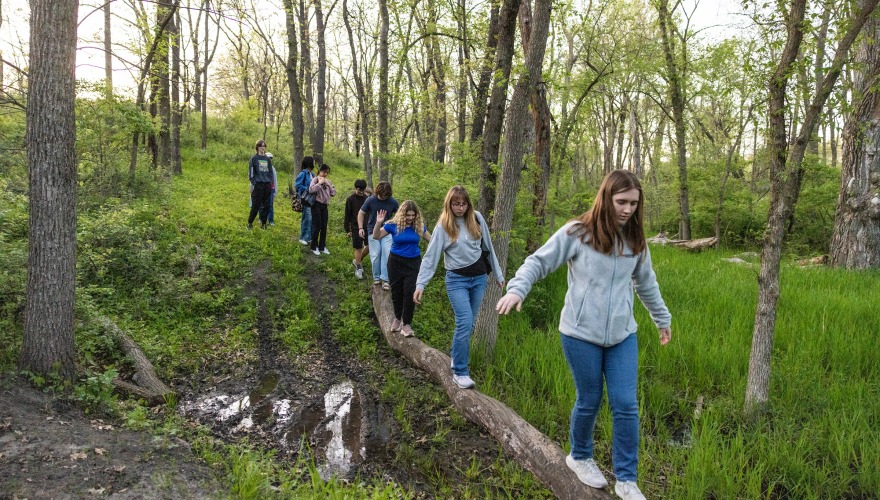
Grinnell College to Launch Environmental Studies Major and Semester at CERA in Fall 2027
New major and immersive, place-based semester will expand opportunities for environmental learning and exploration at Grinnell.
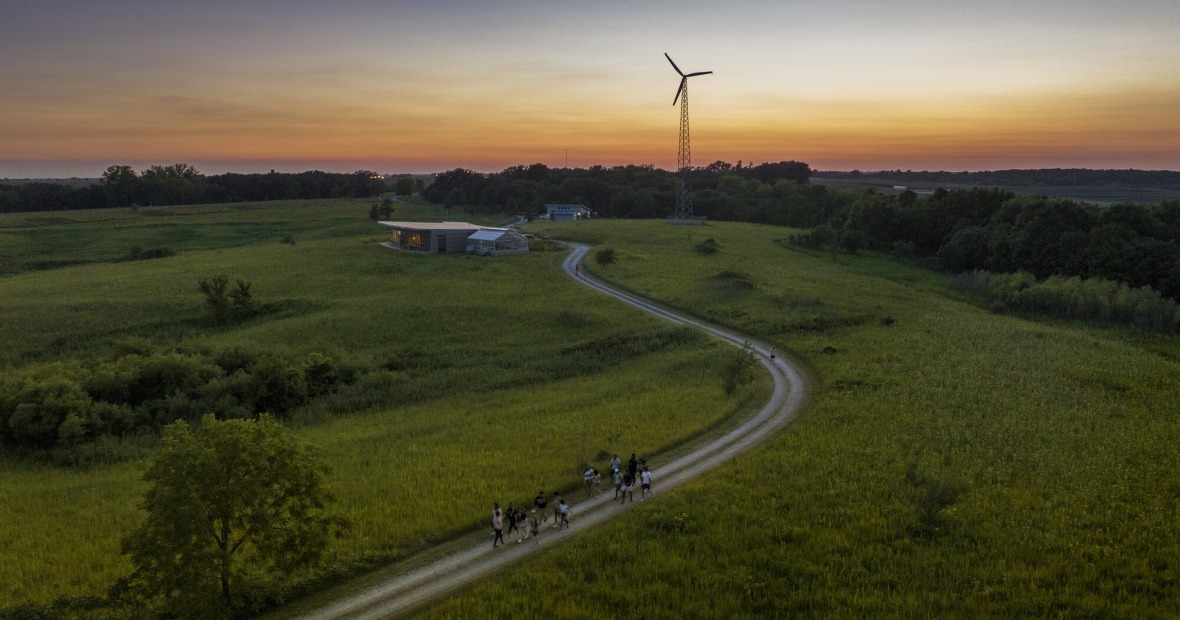
Beginning in fall 2027, students will have new opportunities to study some of the most complex environmental questions facing communities in Iowa and around the world. Building on decades of environmental education at Grinnell, the College will launch a new major in Environmental Studies (ENV), bringing together perspectives from across the curriculum and responding to strong student interest in the existing Environmental Studies concentration. At the same time, Grinnell will introduce Semester@CERA, an immersive program centered at the College’s 365-acre Conard Environmental Research Area (CERA).
Together, the two initiatives represent a significant expansion of environmental education at Grinnell, creating new opportunities for students to connect perspectives from the sciences, humanities, arts, and social ciences while engaging deeply with the places and communities around them.
“Having a strong Environmental Studies program is a natural expression of Grinnell's commitment to the liberal arts – in terms of both the subject matter studied, and also the methodologies students and faculty are employing. The major brings together interdisciplinary inquiry, experiential learning, and thoughtful engagement with some of the most complex and consequential questions of our time,” said Ruth P. Feingold, vice president for academic affairs and dean of the College. “Building on years of faculty leadership and strong student interest, this new major creates additional opportunities for students to connect knowledge across disciplines, deepen their understanding of environmental challenges, and engage multiple perspectives in pursuit of meaningful solutions. Paired with Semester@CERA, it offers an exceptional opportunity to connect classroom learning with place-based experiences and community engagement, enriching students' academic experience and the intellectual life of the College.”
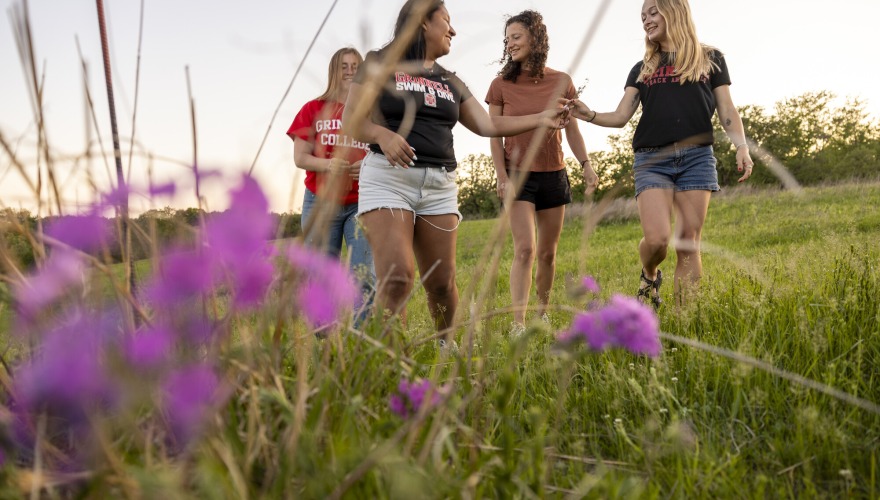
Building on a Strong Foundation in Environmental Studies
Environmental Studies has a long history at Grinnell as a concentration, with students combining environmental coursework with majors across the College. The move to establish a major follows years of study and planning, and promises to make the program both more expansive and also more intentional, with a shared curriculum designed from the ground up.
Students will explore environmental questions through multiple perspectives from across the divisions while developing a thematic area of focus that reflects their individual interests. Shared coursework will bring students together to examine contemporary environmental challenges and responses and culminate in a senior seminar.
The Environmental Studies concentration will continue through the 2027–28 academic year as the major is introduced, allowing the two programs to exist side by side during the transition.
The creation of the major also reflects a broader commitment to strengthening environmental education at Grinnell through interdisciplinary learning, experiential opportunities, and a deeper connection to place. It will provide a more visible academic pathway for prospective and current students interested in environmental studies while positioning the College to contribute to knowledge and public understanding of environmental change and climate change.
Professor and chair of Environmental Studies Peter Jacobson, said, “While the ENV concentration has served students well for years, the new major will provide an opportunity for a far more in-depth exploration of environmental challenges and responses. It will also help build a more connected community of students who will be sharing curricular experiences over the course of their education.”
A Semester Rooted in Place
Also launching in fall 2027, Semester@CERA will give students an entirely new way to learn — spending more time in the field, connecting ideas across subjects, and making CERA an extension of the classroom.
Funded by anonymous donors, the new program will provide an immersive, place-based semester in which students learn with faculty from three different academic divisions. The inaugural faculty team will include Professor Andrew Graham, Chemistry; Professor Hillary Eklund, English; and Assistant Professor Jules Bacon, Sociology.
Students will live on Grinnell’s main campus while spending much of their academic week at CERA and other locations in the field. The first semester will include four interconnected courses: Literature and the Environment, Environmental Sociology, Field Methods in Environmental Science, and Semester@CERA Research and Reflection.
“The vision for Semester@CERA is to provide students with a unique interdisciplinary, place-based learning experience based in the wild spaces and natural laboratory that is CERA, a 365-acre campus that includes remnant and restored tall grass prairie, oak savanna and other woodlands, wetlands, riverine habitats, and the beautiful Environmental Education Center,” said Graham.
The program will move learning beyond the boundaries of a traditional classroom. Longer blocks of time at CERA will allow students to undertake fieldwork, collect and analyze data, pursue research projects, engage with visitors and explore places of environmental and cultural significance throughout Iowa.
For Graham’s Field Methods in Environmental Science course, for example, students will gain practical experience studying water quality, including designing field campaigns, working with instrumentation and analyzing data. The semester format also creates opportunities to observe environmental conditions over time rather than during a single class period or laboratory session.
“The format of the Semester@CERA gives us longer blocks of time to spend outside,” Graham said. “We’ll also be able to engage in longer term monitoring investigations, like seeing how water quality changes over the course of a season.”
Learning Across Disciplines
Just as important as where students will learn is how they will approach the questions they encounter.
Environmental challenges rarely fit neatly within the boundaries of a single academic discipline. Semester@CERA is intentionally designed to bring together scientific, humanistic and social perspectives, giving students different ways to understand the relationships among people, communities and the environment.
“CERA’s history and landscape are deeply embedded with the cultures of Iowa and a long series of human decisions and interventions,” Eklund said. “It’s a great place to break down the nature/culture binary, to educate ourselves about how humans have made and re-made this landscape, and to be intentional about the kinds of imprints we want to leave on our world.”
That spirit of collaboration will come to life in the Research and Reflection course, which Graham, Eklund and Bacon will teach together. Students will draw on different perspectives to develop research projects that connect ideas in new ways, while also taking time to reflect on their experiences, discoveries, and questions throughout the semester.
“The research questions that truly animate us tend to overflow the boundaries drawn by academic disciplines,” Eklund said. “I’m excited to work with my colleagues and students to find different frameworks for understanding our research questions and communicating those questions.”
For Graham, the collaboration is also an opportunity for students to shape the experience through their own questions and interests.
“I’m really excited about the Research and Reflection course, getting to partner with my colleagues Professor Jules Bacon and Professor Hillary Eklund,” he said. “Students will have an opportunity to develop research projects that cross traditional disciplinary boundaries — I’m looking forward to seeing their creativity.”
CERA as a Living Laboratory
The new semester also represents a significant expansion of the role CERA plays in a Grinnell education.
Located approximately 11 miles from campus, the 365-acre field station has long supported class field trips, faculty and student research and opportunities to experience and study the natural environment. Its landscape includes prairie, woodland, wetland and riverine habitats, providing students and faculty with a living laboratory for teaching and research.
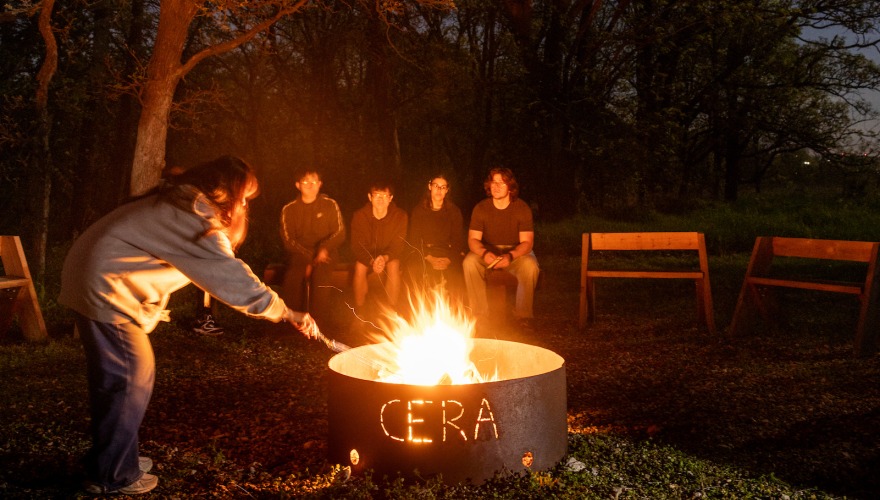
CERA is also a place where environmental science intersects with art, literature, history, and community engagement.
Jacobson, said, “I can't emphasize enough how important CERA is, and will continue to be, for students across the College. Immersed in a sea of industrial agriculture, CERA's landscapes are an invaluable natural laboratory, where students can engage with some of the critical challenges facing humanity.”
“For example, the struggles to sustain agricultural production under changing climates, while also maintaining the integrity of communities and the natural environments on which they depend are as apparent here in central Iowa as around the globe. Iowa is in many respects ground zero for efforts to address such challenges, and it's timely that the College has expanded the curriculum to support students as they prepare to engage in these efforts,” Jacobson added
The Environmental Education Center was the first building in Iowa to receive LEED Gold certification. In 2001, British artist Andy Goldsworthy created “Prairie Cairn” on the grounds. In fall 2025, CERA welcomed its first environmental writer-in-residence, Maria Pinto, beginning a residency program that embeds writers, artists, and other scholars within the landscape and encourages engagement with students, faculty and community members.
CERA is also open to the public for hiking, bird watching, photography, painting, drawing and other forms of studying and enjoying the natural world.
Semester@CERA will build on that history by making the field station an even more integral part of students’ academic experience.
“One of the things that I think makes this program a distinctive liberal arts experience is our emphasis on community building in a very deep sense, with each other as teachers and learners, our neighbors, other living beings, and the very place itself,” Graham said.
A New Chapter for Environmental Studies at Grinnell
The Environmental Studies major and Semester@CERA are designed to complement one another while remaining accessible to students with a range of academic interests.
For Environmental Studies majors who participate in Semester@CERA, coursework from the semester may fulfill both core and thematic requirements within the major, depending on a student’s interests and course of study. But the semester is also designed to bring students from different academic backgrounds together around shared environmental questions.
Together, these approaches reflect Grinnell’s vision for Environmental Studies: giving students a strong academic foundation while creating opportunities to learn through experience and connect their studies to the world around them.
“We’re in an exciting moment for Environmental Studies at Grinnell,” Graham said. “We’re hoping the Semester@CERA program both generates excitement for the new major and serves to more deeply integrate CERA into students’ curricular experience at the College.”
For Graham, the launch also recognizes the generations of people who have shaped CERA into the resource it is today.
“We are super excited for the launch of this program,” he said. “It’s something new, but it’s built on years of faculty, students, and staff making CERA a fabulous place to work, study, and connect to nature. I hope this program honors the vision and effort of the many people who helped make CERA such a special place.”
With the launch of the Environmental Studies major and Semester@CERA in fall 2027, Grinnell is building on that foundation while creating new ways for students to understand environmental change, explore their relationship to place and consider the role they can play in addressing the environmental challenges of the future.