
Making Music, Building Community
“Sounds of Collective Motion” brings Grinnell students and community members together.
Tim Schmitt
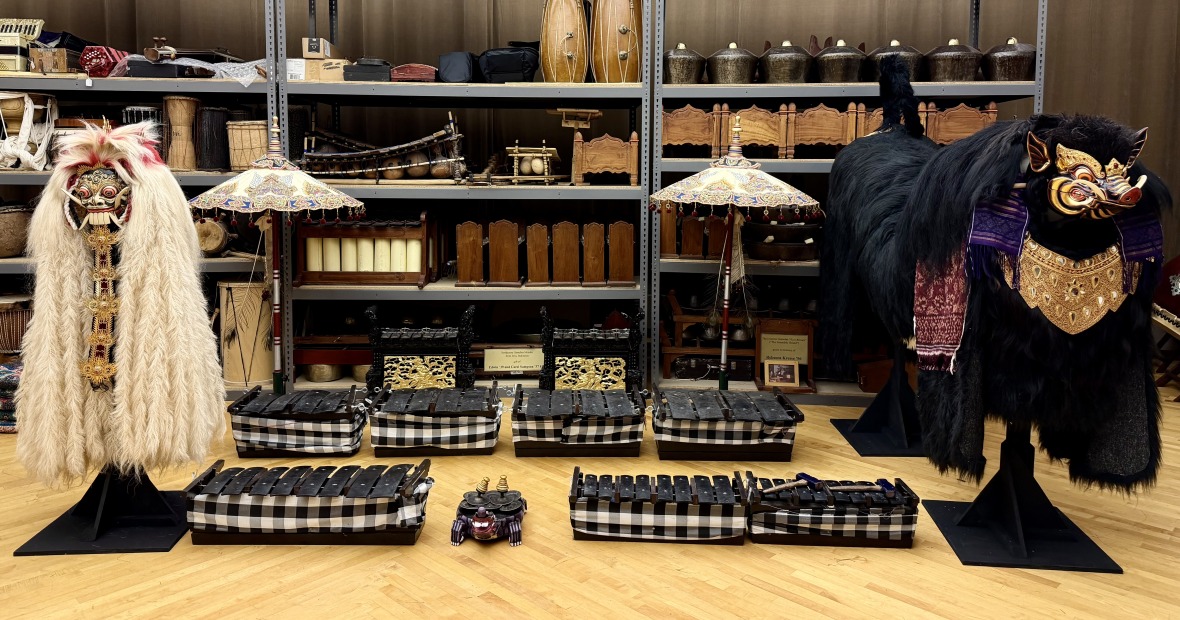
What happens when a college music class moves beyond the classroom and into the community?
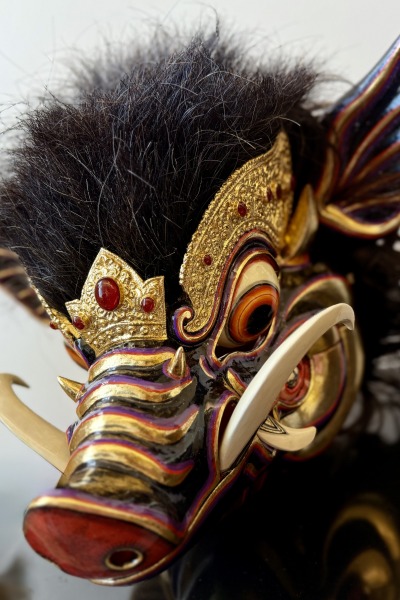
For Assistant Professor Putu Hiranmayena, the answer begins with listening — and then making something together.
This fall, Hiranmayena is teaching “Sounds of Collective Motion,” a Community-Engaged Learning course that explores how people create meaning through sound and movement while considering questions of community, environmentalism, and sustainability.
The course is part academic seminar, part music workshop, and part community experiment. Students spend the beginning of the week reading and discussing theory, then spend the latter half playing instruments, moving together and developing music for public processions.
The goal, Hiranmayena says, is not simply to study music but to use it as a way of bringing people together.
“We do this because it binds community and it allows for the emergence of different kinds of voices in an artistic way,” he says.
From campus to community
Students are working with the College’s Center for Careers, Life, and Service (CLS) to invite local residents to participate in workshops and community sharings. Upcoming workshops will introduce participants to Indonesian musical traditions, including basic rhythms, melodies, and percussion techniques. No musical or artistic experience is required.
Community members will have the opportunity to play instruments alongside students, including drums, gongs and hand cymbals, with bamboo flutes also potentially incorporated. Students are also encouraged to invite people from their own networks.
The collaboration will culminate in a community parade and sharing on Oct. 29, followed by the launch of a new Indonesian Arts collective, ParasWani Kvlektif, at Grinnell College Museum of Art. Later in the semester will be an informal open rehearsal with Hiranmayena’s Balinese Sound Ensemble.
“These are not even performances,” Hiranmayena says. “They’re just kind of community sharings.”
That distinction is intentional. Rather than asking students to prepare for a high-pressure performance, Hiranmayena wants the events to emphasize participation, experimentation and connection.
Those interested can contact Putu Hiranmayena directly or reach out to Julie Lascol for more information.
Learning with, not just about, community
The course also reflects a broader approach to Community-Engaged Learning at Grinnell, where academic inquiry is connected with community knowledge, relationships, and lived experience.
Hiranmayena’s class takes that idea in a particularly musical direction. He teaches students the structures and principles behind Balinese music rather than simply asking them to reproduce established repertoire. Students then experiment with those structures and consider how they can take shape in their own community.
“I want to use that as a way to decolonize and to kind of combat these rigid structures of standardizing not only music but ways of being,” he says.
That process asks students to think about cultural difference not as something that separates people, but as something that can create opportunities for connection.
The course also includes a second community-engaged dimension. Hiranmayena is teaching a parallel section at the Iowa Correctional Institution for Women, where students cannot work with instruments in the same way. Instead, participants use voice and body percussion and exchange recorded work and anonymous reflections with the Grinnell class when permitted.
Together, the two sections demonstrate how community can be built across very different settings.
For Hiranmayena, that is the larger purpose of the course: creating space for people to contribute, listen and make something together.
“It's a way to elevate voices that would otherwise go unheard in a way that's creative and, and quite frankly it's just fun,” he says.