
“Unruly Lines” Connects Art and Research
GCMoA Exhibition Highlights Sonja Sekula’s Works Through Faculty Research, Student Scholarship.
Tim Schmitt
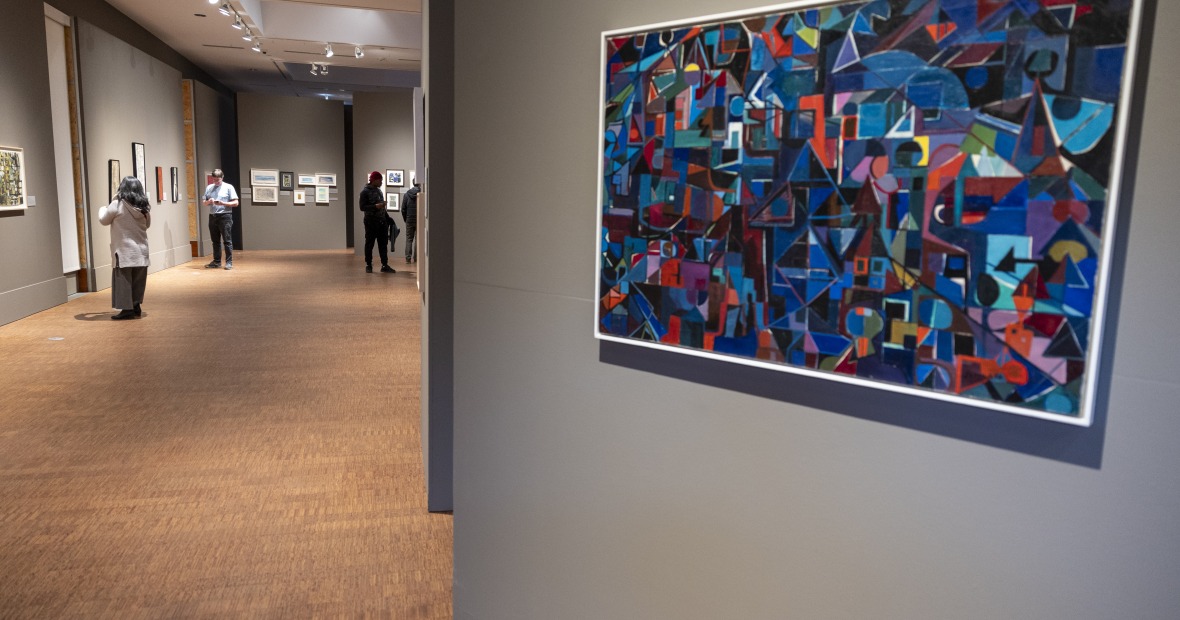
“Unruly Lines: The Art of Sonja Sekula” brings an in-depth exploration of the Swiss-born artist to the Grinnell College Museum of Art (GCMoA), examining a career that unfolded at both the center and margins of surrealist and abstract expressionist circles in Europe and North America.
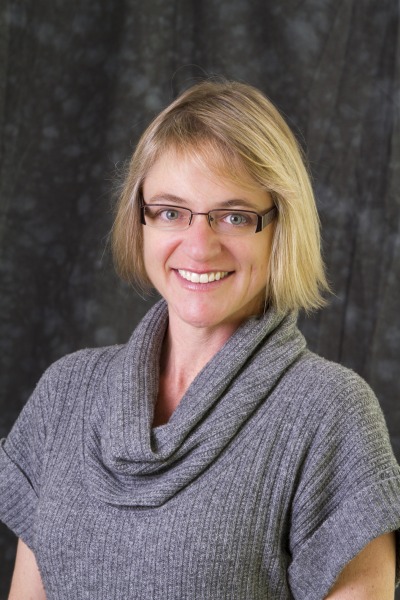
Co-curated by Professor of Art History Jenny Anger and Associate Director and Curator of Exhibitions Daniel Strong, the exhibition represents Grinnell’s ideal of faculty-staff cooperation, and reflects the College’s commitment to integrating teaching, research, and community engagement.
“I was first drawn to Sekula’s works for their incredible variety, ingenuity, and breathtaking beauty,” Anger said. That initial interest developed into years of sustained research that now anchors the exhibition.
Strong said the project grew out of the museum’s collecting priorities and its dual mission of teaching and research.
“Professor Anger first brought Sonja Sekula’s work to the GCMoA’s attention, leading to our first acquisition in 2018,” Strong said. “Additional acquisitions followed, and our discussion of an exhibition — to put our pieces in context — began in earnest.”
For Strong, “Unruly Lines” also demonstrates how the GCMoA supports both faculty and student scholarship.
“With this exhibit, we were not only able to feature Professor Anger’s research, but that of her student, Amy Kan ’27, as well,” he said.
Anger’s scholarship on Sekula has included archival research in Zurich, interviews with surviving colleagues, and access to medical records from a Swiss psychiatric hospital where Sekula had multiple stays. Her broader research examines surrealism’s relationship to gender and mental illness, including how surrealists idealized “feminine madness” even as many women artists experienced mental illness themselves.
Anger’s forthcoming book, “Surrealist Women Artists and Mental Illness,” explores how surrealists framed feminine madness as offering privileged access to the unconscious. An unusually large number of surrealist women artists — including Sekula, Leonora Carrington, Frida Kahlo, and Unica Zürn — experienced mental illness. The book asks whether this ideal of feminized, mad genius proved prohibitive — or productive.
“We dearly hope that Sekula can serve as an example of someone with mental illness succeeding in the world,” Anger said. “At the same time, her art far exceeds her illness, and I would never want to reduce it to that.”
Teaching, Student Research, and Interdisciplinary Learning
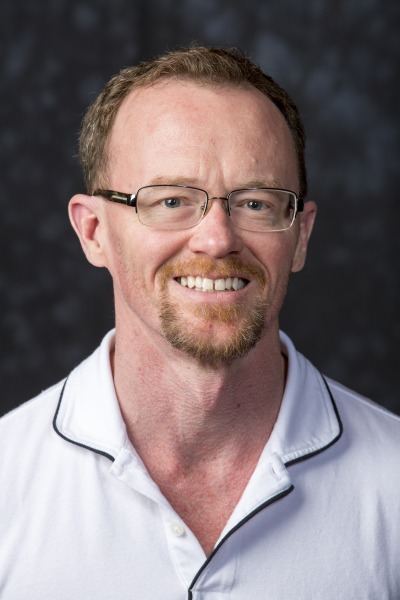
The “Unruly Lines” exhibition has already integrated into coursework and ongoing faculty and student research.
“In preparation for the show, I taught a course on surrealism in 2024,” Anger said. “My book, ‘Surrealist Women Artists and Mental Illness,’ features Sekula, and my student, Amy Kan, contributed to the exhibition catalog and is writing her Mellon Mays Undergraduate Fellowship essay on Sekula. We envision even further research growing from the show.”
Kan’s research into Sekula began in the summer of 2025 while working as a collections assistant at the museum.
“My research on Sonja Sekula was a sprawling endeavor,” Kan said. “Guided by Professor Anger, I read texts on Zen Buddhism alongside little-known archival sources. I built on this research through iterative drafts of papers, public talks and presentations, and, ultimately, publication in the GCMoA catalog.”
Strong said the timing of the museum’s focus on Sekula aligns with renewed international interest.
“We found ourselves, pre- and post-pandemic, in the early stages of renewed interest in Sekula’s work in this country and abroad after decades in obscurity,” he said.
Strong also emphasized the exhibition’s broader message for campus and community audiences.
“Whatever one’s mode of expression — writing, painting, music-making, cooking, playing a sport, or just walking down the street — there isn’t one way to do it,” he said. “Make it your own way. Most important, make it your own.”
“Unruly Lines: The Art of Sonja Sekula” runs through May 31 at the Grinnell College Museum of Art and is free and open to the public. The exhibition will travel to The Gund at Kenyon College later in 2026, extending the impact of Grinnell’s faculty and student research and reinforcing the College’s commitment to collaborative, experiential learning and public scholarship.