
Evolution, Adaptation the Focus of Grinnellians’ Summer Research
I’ve been able to have [Dong’s] class and then go into her research. She’s such a supportive, thoughtful professor. It’s a good example of how students are able to develop very supportive relationships with their professors here.
Three Grinnell College biology students are making the most of their summer break by studying evolution in action through Mentored Advanced Projects (MAPs).
The subject of study for Chloe Pearl ’28, Mariah Mendez ’27, and Matthew Billings-Chiu ’26 is none other than the humble yellow monkeyflower. Under the guidance of Assistant Professor of Biology Caroline Dong, each student is exploring how these wildflowers adapt and survive in a dynamic world.
Impacts of a Hotter Climate
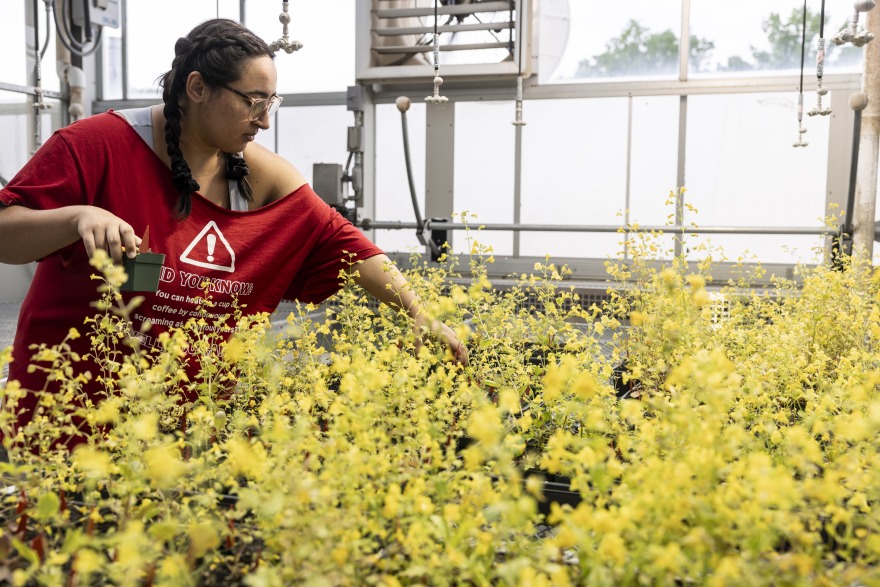
Global warming is predicted to have major effects on Earth’s ecosystems. That’s why Chloe Pearl is testing how monkeyflowers fare under two key climate change factors – increased air temperature and increased carbon dioxide (CO2) levels – for her summer MAP.
Pearl is using four carefully calibrated growth chambers to simulate such conditions. One chamber has increased CO2, another has a higher temp, and a third has both elevated CO2 and temp; the fourth chamber mimics current conditions as a control.
“I’ve seen that my chamber with elevated temperature and the chamber with combined elevated temperature and CO2 started growing and flowering faster,” Pearl said.
A full data analysis will reveal more detailed conclusions from her experiment, but Pearl’s takeaways from her MAP experience extend well beyond the results of her research.
“In my normal classes, I have to split my focus,” she said. “With my MAP, it’s much more focused – my project is all I’m doing every day, and that is so exciting."
With that greater focus comes freedom to delve into the details of her experiment. Pearl said she enjoys applying her skills from her normal classes and labs in that exploration.
Mixing, Matching, and Adapting
Monkeyflowers come in an array of varieties, and some have special adaptations to match their habitat. Matthew Billings-Chiu analyzed how well two sets of hybrid flowers adapted to survival in their parent varieties’ ecosystems.
One of the parent varieties, commonly known as the cutleaf monkeyflower (Mimulus laciniatus), is well-suited to life in a rocky, granitic environment. The other parent, a variety of M. guttatus, prefers a meadowy habitat.
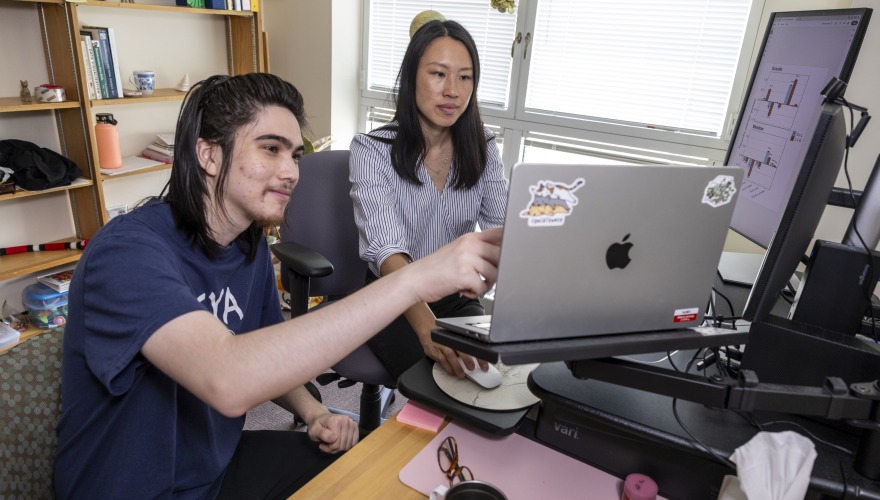
“The data is showing, essentially, that maternal habitat is important,” Billings-Chiu said. “Reciprocal hybrids do seem to be facing different selective pressures. We think there are specific genes that are only passed down through the maternal line which impact these selective pressures.”
Compared to his classes during the regular academic year, Billings-Chiu said his MAP allowed him to use more computational biology tools.
“Another thing that really made the MAP stand out is that it can really be tailored toward some of your personal interests,” he said, adding he would encourage the MAP experience to fellow students.
An Ultraviolet Experiment
There’s more than meets the (human) eye when it comes to monkeyflowers. As flowering plants, monkeyflowers rely on pollinators to reproduce, and ultraviolet (UV) light is one tool they use to that end.
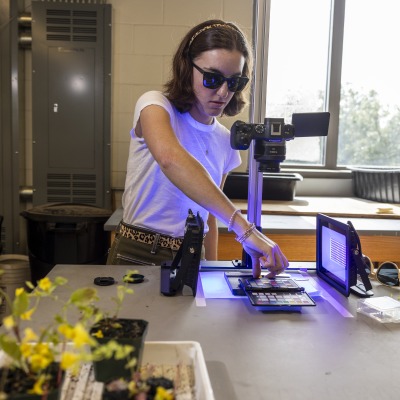
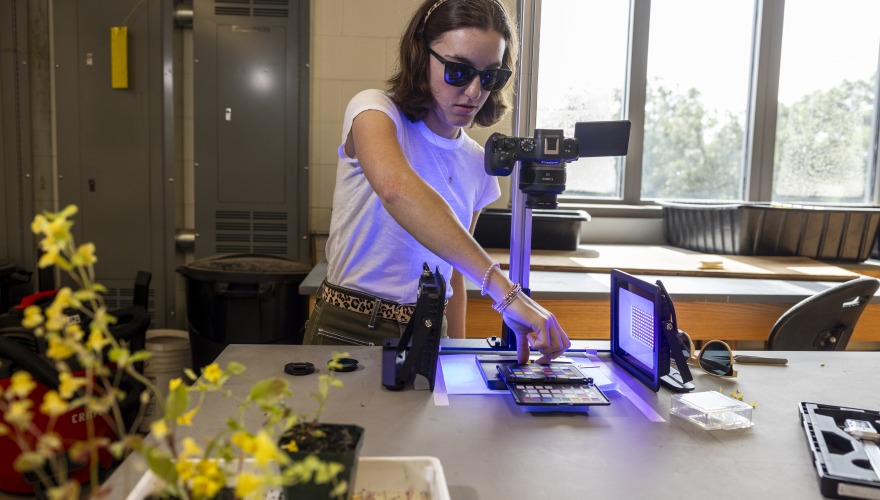
Such UV light patterns are the focus of Mariah Mendez’s summer MAP. She compared the size and concentration of UV light patches on a hybrid bred from the meadow-dwelling M. guttatus and high-altitude M. laciniatus.
Mendez analyzed data on how the hybrid monkeyflower performed in each of its parents’ native habitats.
“From the literature review I’ve done so far, it looks like the higher altitude flowers will have a larger UV signature,” Mendez said. “The size of the UV patches was surprising.”
Her initial hypothesis was that these hybrids would come to have larger UV patches because of findings from a previous research paper on the subject, and due to an inclination that plants at higher altitudes will emphasize patches to attract the attention of a sparser pollinator population.
“This project has really taught me to be self-sufficient. You have to be very independent,” Mendez said. “Especially for STEM students, if you’re doing a research project, I think it’s a really good option and will help you a lot.”
Summer MAPs: Real-world Experiences Guided by Real-World Scholars
Through each of their MAPs, Pearl, Billings-Chiu, and Mendez have cultivated critical skills needed to succeed in their fields of interest. As their mentor, Dong has sought to maximize the benefits of their experience.
“When possible, I try to work with students so they have input in the experimental design and analysis,” Dong said. “I try to identify skills that they want to develop so that they feel excited and fulfilled by their summer research.”
She said the biology department has a very research-oriented curriculum, but MAPs allow students to go above and beyond what they can practice in class.
Dong added that Grinnell College provides funding for students to attend a conference, another valuable experience to complement their academic year education.
Pearl, Billings-Chiu, and Mendez all said their close correspondence with Dong enhanced their MAP experience.
“I’ve been able to have [Dong’s] class and then go into her research. She’s such a supportive, thoughtful professor,” Pearl said. “It’s a good example of how students are able to develop very supportive relationships with their professors here.”
This story is part of Grinnell College’s summer experiential learning series. This year, the College is investing more than $1.2 million to support Mentored Advanced Projects (MAPs) and student internships, creating opportunities for students to pursue original research, creative scholarship, and hands-on learning on campus and around the world. Read more about Grinnell's investment in experiential learning.