
How a Simple Word Became “Cool”
A summer Mentored Advanced Project explores the history of one of English’s most enduring words.
Tim Schmitt
Why has one slang word endured for generations while countless others have faded away?
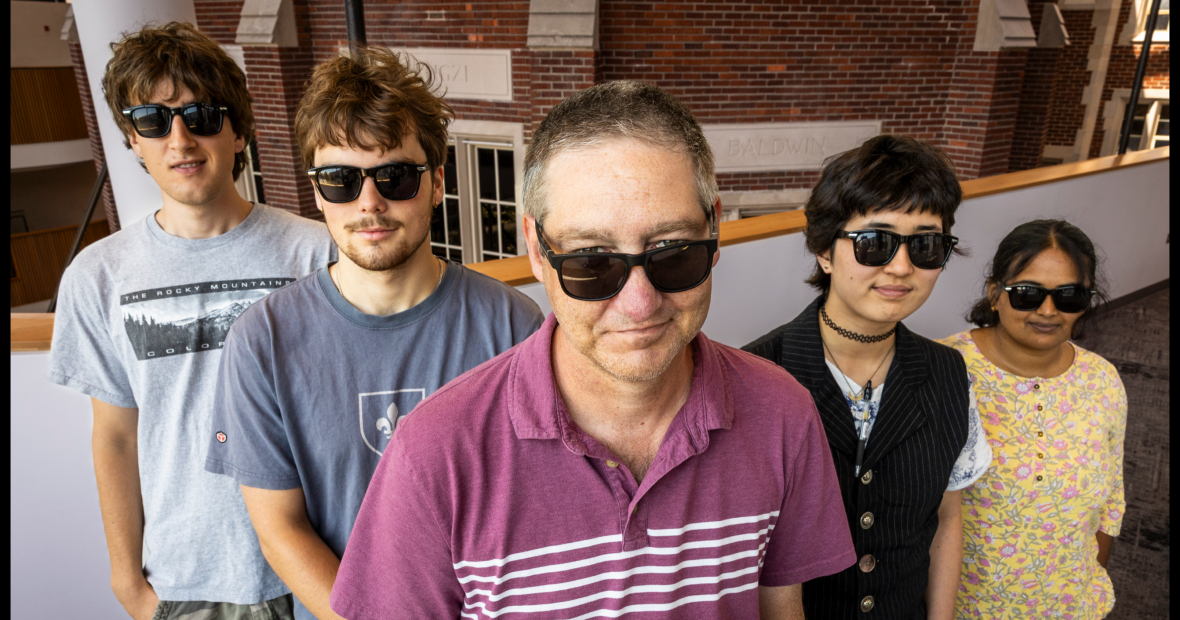
That’s the question driving a summer Mentored Advanced Project (MAP) led by Professor of English Tim Arner, who, alongside four Grinnell students, is tracing the remarkable history of the word “cool” from its roots in African American communities to its place in everyday conversation.
The project is part of Arner’s broader scholarship on linguistic justice, which examines how attitudes toward different varieties of English shape perceptions of the people who speak them.
“One of the things I’m especially interested in is the word ‘cool’,” Arner says. “It’s been identified as originating, in the sense of ‘stylish’ or having a certain flair, in African American slang during the jazz age.”
Arner and his team of students are exploring how the term spread through jazz, literature, film, and popular culture before becoming a fixture of mainstream American English. Along the way, they’re asking larger questions about language, race, and cultural exchange.
“We’re interested in the places where that exchange happened,” Arner says, “and the people in the 1940s and ’50s who were shaping it.”
Research Through Mentorship
While the research contributes to a chapter in Arner’s forthcoming book, the MAP is equally about mentoring students as emerging scholars.
Each student investigates a different aspect of the story, from historical slang dictionaries to literary representations of Black language and the Beat Generation. Together they read novels by Richard Wright, Ralph Ellison, and Jack Kerouac, analyze films from “Casablanca” to “Cool Hand Luke,” and develop independent research projects that will culminate in presentations at the Humanities and Social Studies Center poster session.

For English major Adyasha Anindita ’28, the experience has transformed the way she approaches research.
“Research often feels like a huge puzzle,” she says. “You don’t know where to start or where to end.”
But she credits Arner’s mentorship with helping her and her fellow researchers navigate that uncertainty.
“He’s really supportive,” Anindita says. “He recognizes that for many of us it’s the first time we’ve done research like this. He tells us there’s no reason we should get everything right the first time, and if we run into roadblocks, we can always come talk to him. I think that’s been really helpful.”
Learning to Think Like a Scholar
Anindita’s project examines why “cool” survived while contemporaries such as “hip” and “jive” largely disappeared. Her research has required digging through historical dictionaries, evaluating sources, and refining a hypothesis through evidence rather than assumptions.
Beyond the findings themselves, she says the MAP has strengthened the habits of mind that define a Grinnell education.
“Grinnell does a really good job of teaching students to think critically in class,” she says. “But during this project I had the time to really sit with a question, think through it carefully, and come to my own conclusions instead of simply relying on sources. The sources provide the information, but the thinking has to come from me. This MAP has been a really good opportunity to learn how to do research, but more importantly, how to develop focus and discipline while doing research.”
For Arner, that’s the lasting value of the project. The team’s research may help explain how “cool” became one of the English language’s most enduring words, but the project’s greatest impact is on the students themselves. Through curiosity, collaboration, and careful scholarship, they’re discovering that meaningful research isn’t just about finding answers — it’s about learning how to ask better questions.
This Mentored Advanced Project is one of hundreds of experiential learning opportunities supported by Grinnell College this summer through more than $1.2 million in funding for internships and research opportunities.