
Rethinking AI Through Research and Play
A summer MAP helps Grinnell students explore how to use artificial intelligence thoughtfully — by strengthening the human skills AI can’t replace.
Tim Schmitt
As generative artificial intelligence reshapes classrooms, workplaces, and daily life, Professor of Computer Science Fernanda Eliott believes one of the most important questions isn't what AI can do — it’s how people can continue thinking deeply alongside it.
That question is at the heart of Eliott’s Summer Mentored Advanced Project (MAP), the Cognitive Robustness Studio, an interdisciplinary research experience that invites students to examine how AI is changing society while developing habits that strengthen critical thinking, creativity, and human connection.
The project is one branch of Eliott’s research lab, ELBICA (Enhancing Lives with Biologically Inspired Computational Approaches), and complements another summer MAP focused on reinforcement learning. Together, the projects reflect Grinnell’s commitment to pairing rigorous research with close faculty mentorship and encouraging students to tackle complex questions that extend beyond disciplinary boundaries.
“The main question we are asking is: How can we enhance students’ cognitive robustness in a world where generative AI tools are popping up everywhere?” Eliott says.
Rather than treating AI as something to embrace unquestioningly or avoid entirely, the studio encourages students to think critically about how technology influences learning, relationships, and decision-making.
“The technology is here, so we must learn to use it in the best possible ways,” Eliott says.
Students as Researchers — and Test Subjects
Like many summer MAPs, the Cognitive Robustness Studio blurs the line between learning and research.
“When I first came into the MAP, I thought I was going to help Professor Elliott come up with an AI literacy course,” says Jenifer Silva ’27, a computer science major with a concentration in education and digital studies. “But it turns out she already had a plan for us. While we were doing research with her, we were also acting as test subjects.”
Eliott received Institutional Review Board (IRB) approval run the project, which had students read research spanning computer science, psychology, education, philosophy, and cognitive science. They also explored topics ranging from emotion and entertainment to cybersecurity and the ethical implications of generative AI. Just as importantly, they reflected on how those ideas affected their own thinking.
“We were both researchers and our own test subjects,” agrees Edgar Romero ’29 a computer science and economics major. “We looked at ourselves and asked ‘Do I communicate with AI differently? What impacts does this have on my psyche and how I communicate with other people in an AI context?’
“The primary goal behind all this is to increase what’s called cognitive robustness,” he adds, “The goal isn’t to say whether AI is good or bad, but rather to understand the risks and benefits it brings and make clear recommendations on how people should use it.”
That interdisciplinary approach reflects a hallmark of Grinnell’s liberal arts education. Classics major Paul Reif ’26 brought a humanities perspective to conversations about empathy and ethics, while Mansi Singh ’29 and Romero contributed emerging perspectives from computer science.
“A core part of our work this summer was collaboration, as we all come from very different academic backgrounds,” Reif says.
Creating a Common Language for AI
One of the studio’s signature projects was developing Cognitive Derivation Stamps — visual badges faculty can place on assignments or syllabi to clearly communicate how AI may be used in a course.
The stamps range from categories such as “Minor Editing” and “Major Editing” to discipline-specific uses, helping establish a consistent vocabulary while recognizing that acceptable AI use differs across academic fields.
“A big reason they exist is to destigmatize AI usage and convey rules in a clear manner,” Singh says. “We put a lot of work into designing them, so AI isn’t represented negatively, but rather framed as a tool.”
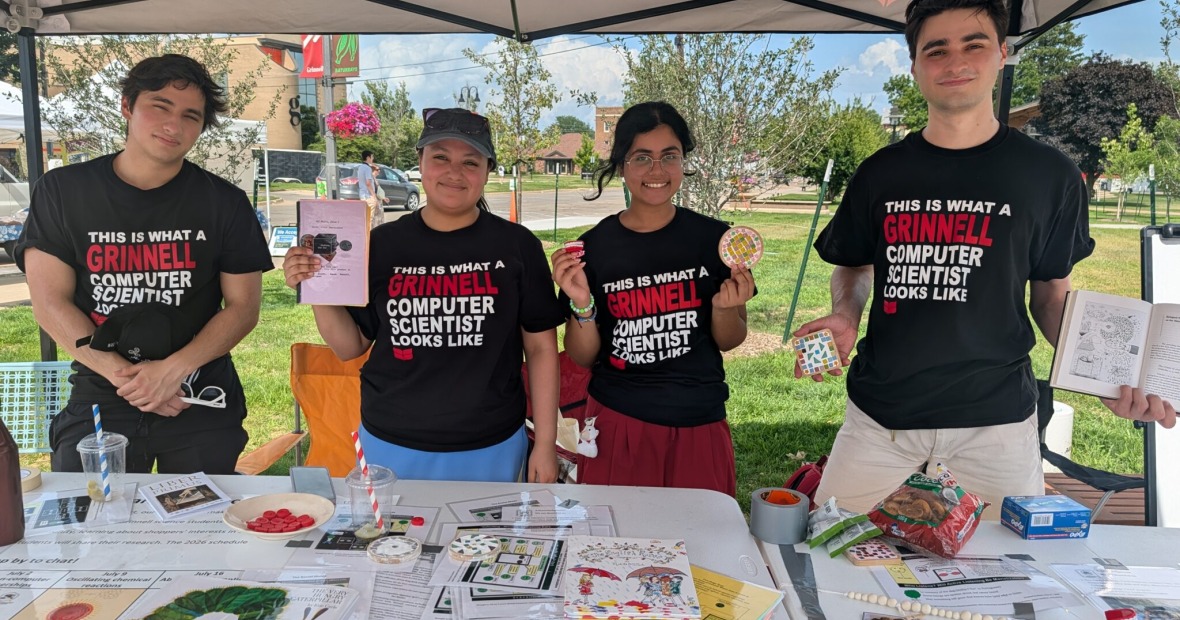
The students also shared their work beyond campus research meetings. They gathered feedback at Grinnell’s Market Science booth during the local farmers market, presented ideas to campus leaders, and are preparing a paper for the 2027 ACM SIGCSE Technical Symposium on Computer Science Education.
“The stamps provide a common language for something that has otherwise been running rampant and uncontrolled,” Reif says.
Rediscovering Creativity
Perhaps the most unexpected part of the project happened every Friday.
During a weekly “Analog Lab,” students unplugged completely from technology to work with clay, create mosaics, make paint from natural materials, produce handmade zines, explore the Stew Maker Space, and experience music and books outside their usual interests.
Eliott admits she wasn’t sure how computer science students would respond.
“The Analog Lab was a huge surprise,” she says. “I wasn’t sure if students would view it as useless or trivial. But they ended up loving it. They looked forward to Fridays because it allowed them to bond and step away from screens.”
For Silva, those sessions became one of the summer’s most meaningful experiences.
“During the Analog Lab, I personally started going to the Maker Space,” she says. “Not only was I trying new things, but I was also connecting with the community. It felt like tapping back into childhood creativity rather than just focusing purely on technical research.”
Singh agrees that the unplugged sessions became an essential part of the research.
“It helped us bond as a group and take a necessary step back from technology to build our own creative habits,” she says.
Preparing Students for an AI Future
The Cognitive Robustness Studio is laying the foundation for a future Grinnell course on AI literacy and cognitive robustness, with students directly influencing its design. Their work demonstrates how Summer MAPs extend classroom learning by inviting students to become collaborators in meaningful scholarship.
For Eliott, that’s the ultimate goal.
Rather than teaching students to fear AI or rely on it unquestioningly, the project encourages them to develop the distinctly human qualities that will remain essential no matter how technology evolves: curiosity, creativity, ethical reasoning, and the confidence to ask better questions.
This story is part of Grinnell College's summer experiential learning series. This year, the College is investing more than $1.2 million to support Mentored Advanced Projects (MAPs) and student internships, creating opportunities for students to pursue original research, creative scholarship, and hands-on learning on campus and around the world. Read more about Grinnell's investment in experiential learning.