
2026 Commencement Charge Given By President Anne F. Harris
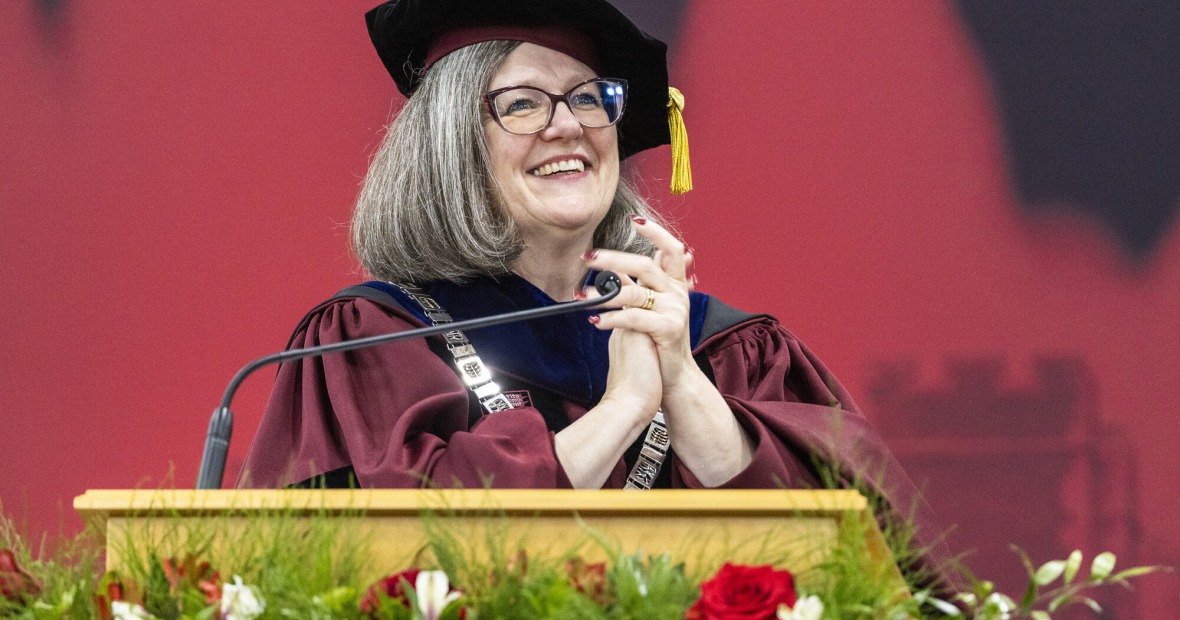
The Commencement Charge is a last opportunity in this ceremony to think together; to bring forth an idea to hold among us, in honor of your years of academic study and collective experience at Grinnell. It is thus my great honor to present my charge to you, the graduating class of 2026.
“I studied, I loved, I labored, unsparingly and hopefully.”
I have turned to these words many times in my life, but this will be the first time that I share them with students… graduates. They have held me in good stead in all sorts of times and I offer them to you with the discovery of fresh research that revealed that, of course, they have a Grinnell connection.
“I studied, I loved, I labored, unsparingly and hopefully.”
Those words were written in 1914 by the Harvard professor and philosopher Josiah Royce in an essay entitled “A Word for the Times.” Published on the eve of World War I, it was written for an uncertain global future, seeking to articulate deeply human actions that would, against all odds and challenges, strive to safeguard community, strive to safeguard the good that we nurture among and for each other.
“I studied, I loved, I labored, unsparingly and hopefully.”
Professor Royce’s student, president Franklin D. Roosevelt, quoted those very words in his 1936 State of the Union address, given in the heart of the Great Depression. Sitting with the president’s cabinet members was Harry Hopkins, a Grinnell graduate, and architect of the New Deal, a bold government program designed to bring economic relief to communities across the nation. As a wondrous part of the New Deal, Harry Hopkins would reach out to his Grinnell College friend, Hallie Flanagan, who would work to create and sustain community through government-sponsored theater for all.
“I studied, I loved, I labored, unsparingly and hopefully.”
In these words, Josiah Royce articulated the conditions of possibility for his concept of “beloved community,” a concept much better known through its amplifications by the Rev. Dr. Martin Luther King Jr., whose last book, Where Do We Go from Here: Chaos or Community, published in 1967, the same year of his visit to Grinnell College, outlined for the last time his vision for a “beloved community” and the justice needed to sustain and lift up a multi-racial society of opportunity and reciprocity, a “beloved community” for the common good and the nurture of life, liberty, and the pursuit of happiness.
Community is not a given.
The common good is not a given.
Many truths are not, it turns out, self-evident.
And yet, here you are, class of 2026, resplendent and resolved. Over the last four years, your brilliant, steadfast, creative, jubilant, and persevering work to build and sustain community, to look out for each other and the world, place you in the legacy of these champions of community in your time at Grinnell.
Dear Class of 2026, “[may you] study, [may you] love, and [may you] labor, unsparingly and hopefully” – in your loving labor for community, you have created a legacy of connection and possibility and joy at Grinnell. And that is why, it truly gives me hope for the world to be able to say to you, the class of 2026, “Go forth, Grinnellians.”