
Grinnell Rocket Team Lifts Off
Student-led team turns curiosity into hands-on aerospace engineering experience.
Tim Schmitt
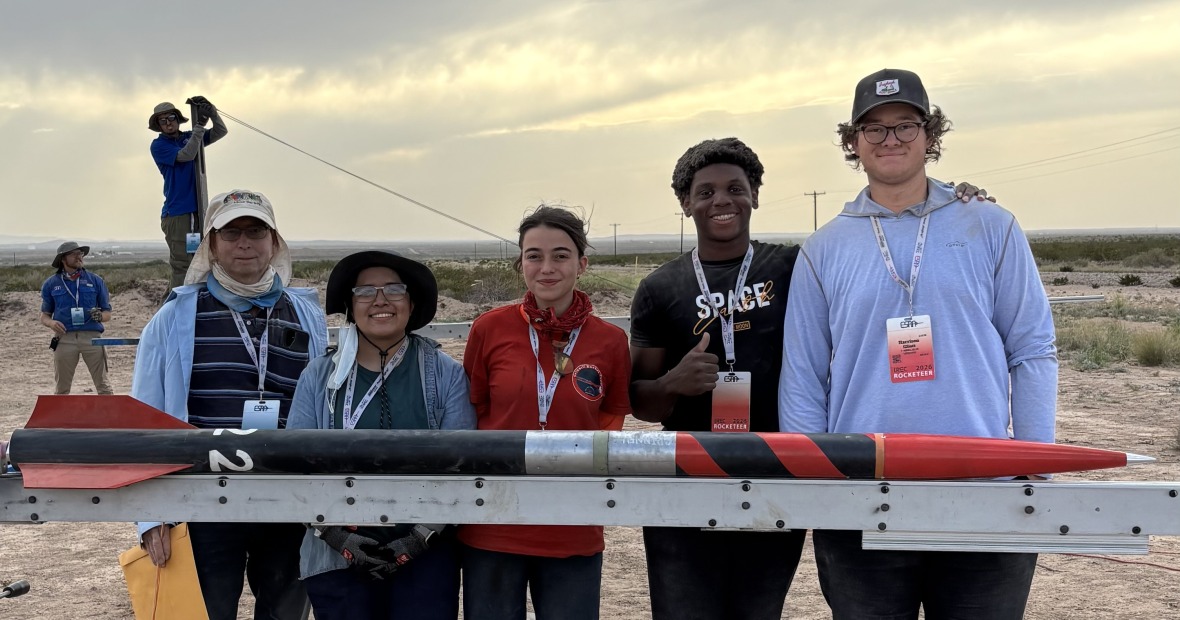
Sophia Ramalli ’27 came to Grinnell with hopes of launching not only her education, but also her interest in rocketry and aerospace.
“I’ve always wanted to have contact with rocketry, and I want to work in it as well,” said Ramalli, an upcoming senior physics major and founder of the Grinnell Rocket Team. “Trying to have that engineering background in my undergrad was really important for me, so that’s why I wanted to create this club that would have applied physics and engineering everywhere.”
What began as a small student effort has grown into a working rocketry team that designs, builds, and launches high-powered rockets, competes internationally, and reflects Grinnell College’s commitment to student-driven learning that connects academic study with hands-on experience.
From Idea to Launch Team
In its early years, the Rocket Team was more ambition than structure. A small group of students met wherever space was available, including the Noyce Science Center basement, learning rocketry fundamentals as they went.
“Getting members involved was challenging in the first two years, it was really more of an idea than a club itself,” Ramalli said. “We were still learning how to launch rockets.”
As interest grew, students connected with regional launches through the Iowa Society of Amateur Rocketeers and built toward certifications in high-power rocketry. A major milestone came with their first successful high-power launch, a rocket named Princess, which helped establish the team’s momentum.
Learning by Building
For Ramalli, the team fills an important gap: the opportunity to apply physics in a tangible, collaborative way.
“I think Grinnellians are really smart and really committed,” she said. “We all want to do things bigger than just taking classes.
“Shira Sheppard ’27, our avionics lead and vice president, has developed amazing simulation skills on a platform called ‘OpenRocket’ which enabled us to predict the behavior of our rocket during launch, and it was really accurate,” she added. “Harrison Elliott ’29 (also a member of the Men’s Golf Team) and Eti-Abasi-Laurel ’28, our payload and structures leaders, successfully demonstrated the technology of our payload and made it work during launch. Finally, our recovery leads, Stephany Ronquillo ’28 and Carmela Davidson ’28, did an impressive job during preparation and on-site so that our rocket launched safely with no parts flying off.”
That emphasis on experiential learning aligns with Grinnell’s mission to encourage students to integrate knowledge across disciplines and apply it beyond the classroom. In the Rocket Club, physics and engineering concepts become real through design, testing, and launch.
Faculty mentorship from and external guidance have also been essential, including certification support from licensed rocketry professionals like Lanie Cross.
“I certified Sophia for her Level 1,” Cross said. “I’m a Technical Advisory Panel TAP member with Tripoli Rocketry Association.”
Level 1 certification enables a member to buy and fly rockets powered by specific motors, is the first step into high-power rocketry. and teaches the basics of safe, large-scale flight.
Community Support and Collaboration
The team’s growth has depended on strong campus and community support. Donated equipment and logistical help have made participation in competitions possible.
“Craig and Monique Shore ’90 really helped us,” Ramalli said.” “Not only did they provide rockets like our Dominator 4 that we used in competition, they also provided the hardware we needed, which was helpful because those things cost around $700.”
Administrative support has also been critical.
“We also got a lot of help from Shanshan Rodriguez, our faculty supervisor, and Maure Smith-Benanti, who helped us arrange our hotel, flight tickets, and rental car. If it wasn’t for her, we wouldn’t be where we are.”
Competing on the International Stage
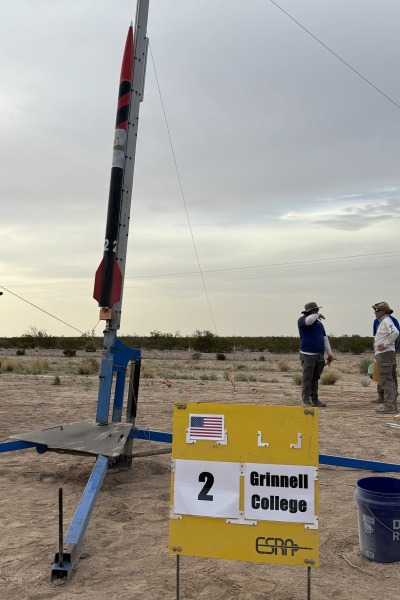
The team recently competed at the International Rocket Engineering Competition (IREC) in Midland, Texas, the world’s largest student rocketry competition.
“There were people from so many countries — not only from the U.S., but from Europe and South America as well,” Ramalli said.
Competing in the 10,000-foot Commercial Off-The-Shelf category, Grinnell’s team launched a student-assembled rocket and tested a payload measuring vibration impacts using accelerometers.
The launch included a setback when an ignition issue arose, but collaboration on the field quickly solved it.
“The Iowa State team literally came running across the field and brought us one of their spare igniters,” Ramalli said. “Then the launch happened. They were so happy, we were crying, and we were happy too. It felt like one big family.”
The team also earned recognition from judges for their perspective.
“You brought a physics group to an engineering competition. I got respect for you,” one judge said, according to Cross.
Looking Ahead
As senior members prepare to graduate, the team is focused on continuity and growth. Recruitment is a priority, especially among incoming students who may not realize opportunities like this exist at Grinnell.
“We really want incoming first-years to see what our rocket looked like and how we’re growing as a team,” Ramalli said.
Plans include displaying a rocket on campus, expanding outreach, and strengthening partnerships with other universities.
For Ramalli, the goal is simple: ensure future students can keep building, launching, and learning.
In doing so, the Rocket Team reflects Grinnell College’s mission to empower students to connect learning with action, curiosity with creation, and ideas with impact.